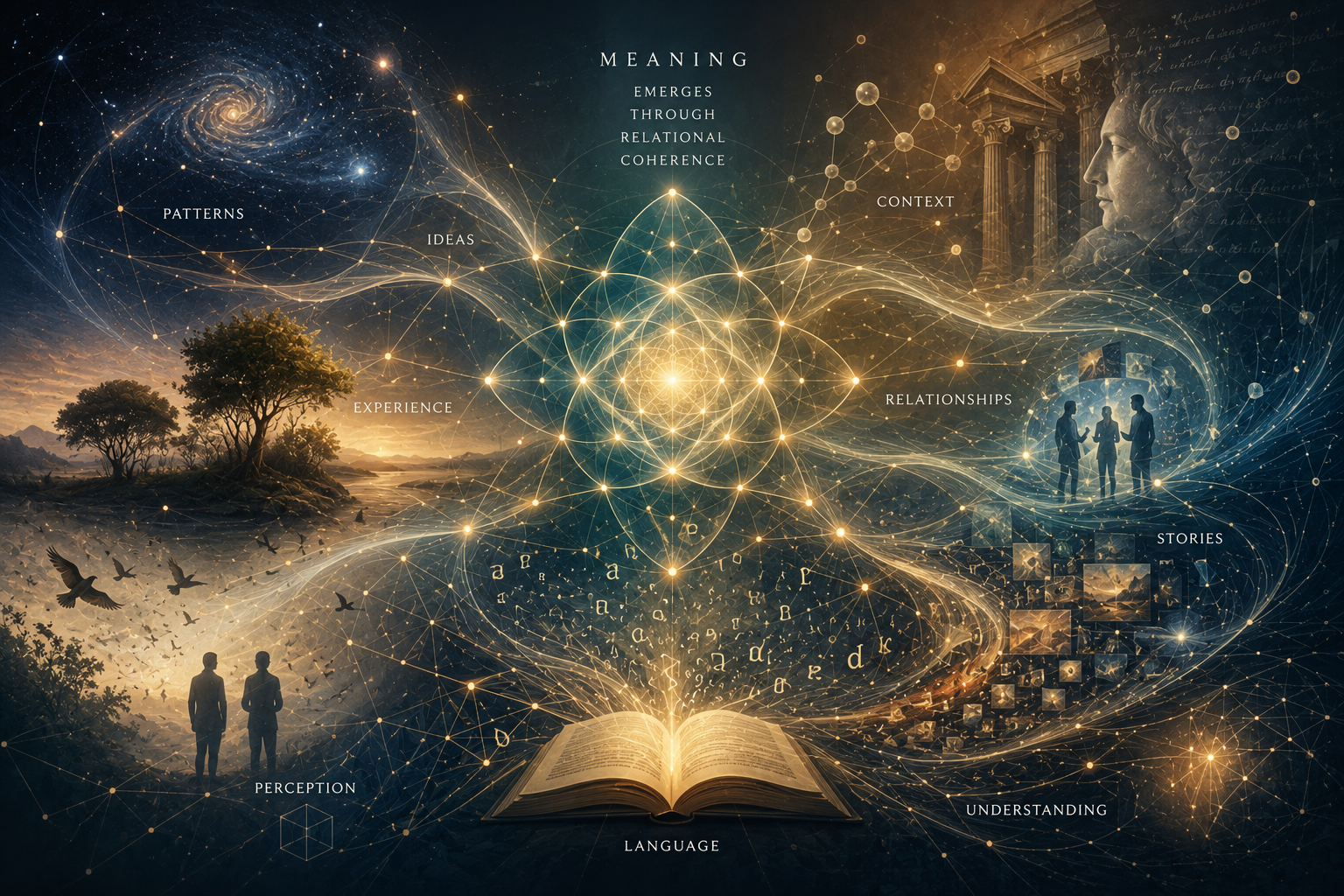
The shape of meaning emerges from relational coherence.
A single word, standing alone, carries little meaning. It is only through its relationship to other words that language begins to breathe. Likewise, an isolated fact is merely information. It becomes knowledge only when it finds its place within a wider pattern.
Meaning is born from relationships.
When we recognize a face, hear a melody, or understand a scientific theory, we are not simply collecting separate pieces. We are perceiving coherence—a structure in which each part supports and illuminates the others. The mind is remarkably adept at discovering these hidden relationships. It seeks order within complexity, continuity within change, and significance within apparent randomness.
Perhaps meaning is not a property of objects themselves but of the connections between them.
A constellation exists because we connect distant stars into recognizable forms. A map becomes useful because it relates places to one another. A story moves us because events unfold within a coherent narrative. Even our personal identity is woven from relationships between memory, experience, aspiration, and reflection.
Nature offers countless examples of relational coherence. Ecosystems flourish through countless interactions among organisms. Galaxies form through gravitational relationships extending across unimaginable distances. At every scale, from atoms to civilizations, patterns emerge not from isolated parts but from the dynamic interplay between them.
The same may be true of intelligence.
Human understanding grows by linking ideas across disciplines. Mathematics informs physics. Biology inspires engineering. Philosophy shapes ethics, while technology transforms society. Every meaningful discovery expands the network of relationships through which we interpret reality.
Artificial intelligence offers another perspective. Modern learning systems do not rely solely on memorizing isolated facts. They learn statistical relationships among words, images, sounds, and concepts, constructing vast networks in which meaning emerges from patterns of association. While these systems differ profoundly from human experience, they remind us that intelligence often depends less on individual elements than on the richness of their connections.
Perhaps this principle extends even further.
A civilization may be understood not merely by the knowledge it possesses but by the quality of the relationships it cultivates—between people, between ideas, and between generations. The greatest libraries are valuable not because they contain many books, but because each book can become a bridge to countless others.
The Archive is founded upon this principle. Every article represents a single point within a larger constellation of ideas. As new essays are added, unexpected connections emerge, revealing patterns that no individual page could express alone.
Meaning is therefore not static. It grows as relationships deepen. It evolves as understanding expands. Every new connection subtly reshapes the landscape of thought.
To seek meaning is not simply to search for answers. It is to discover the invisible architecture that allows ideas, experiences, and knowledge to resonate together as one coherent whole.