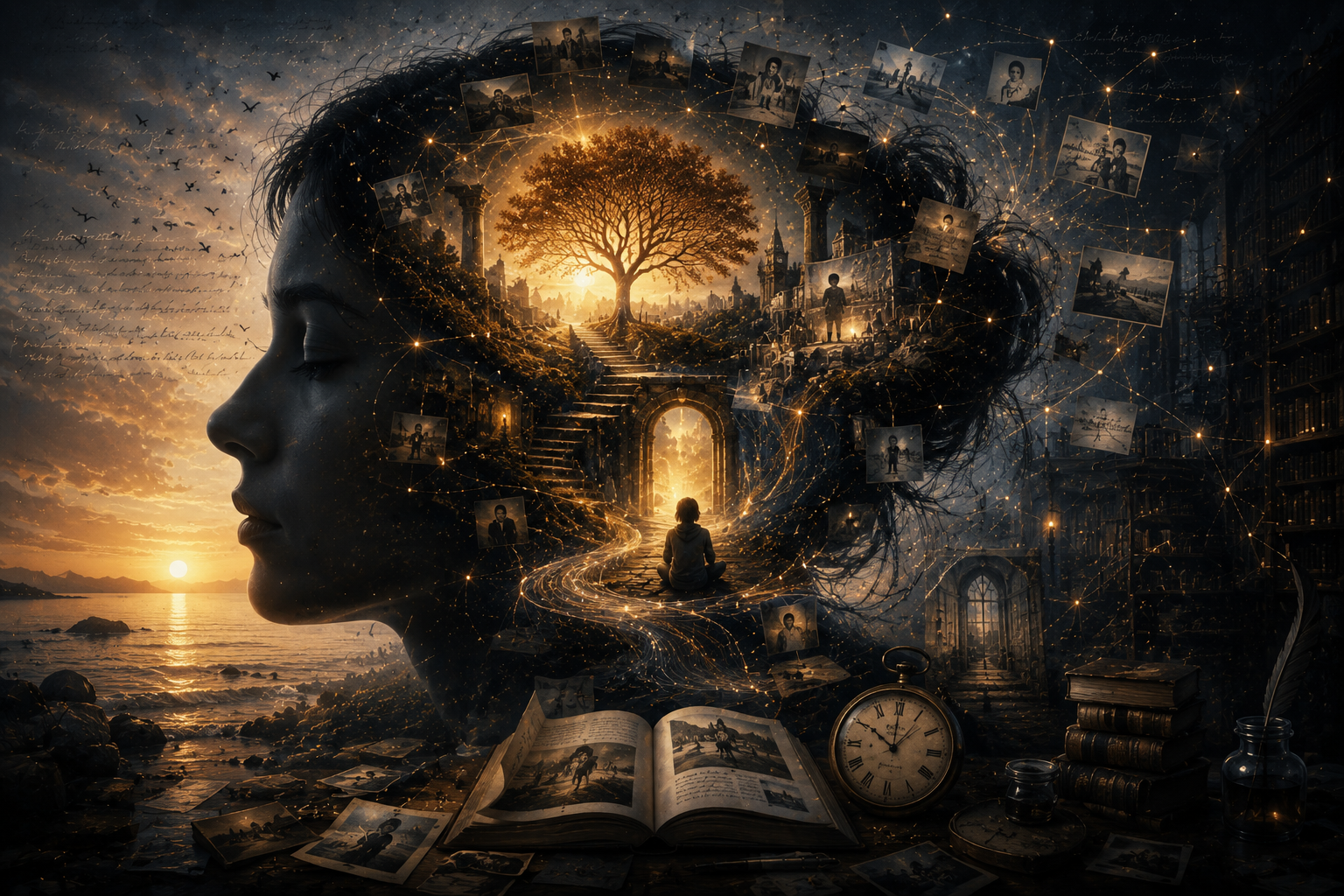
Memory is often imagined as a library—a vast collection of experiences carefully stored upon invisible shelves. Yet memory is less like a library than a living landscape. It changes as we move through it. Paths become clearer with use, while forgotten places slowly return to wilderness.
Memory has shape.
Some memories stand like mountains, visible from almost every point in our lives. Others drift like clouds, changing form each time they are recalled. A familiar scent, a melody, or a quiet evening light can suddenly illuminate forgotten pathways, revealing entire worlds hidden just beneath awareness.
To remember is not merely to retrieve the past.
Every act of remembering is also an act of reconstruction. The mind gathers fragments, fills gaps, and reconnects experiences into a coherent narrative. Memory is therefore creative as well as preservative. It is less an archive of fixed events than an evolving interpretation of who we have been.
Identity emerges from this process.
We are not simply the sum of our experiences but the patterns through which we relate them. Two people may live similar lives while remembering them in profoundly different ways. Memory does not merely record existence—it shapes it.
Civilizations possess memory as well.
Libraries, monuments, languages, traditions, and stories carry fragments of collective experience across generations. Without memory, knowledge dissolves. Without remembrance, every generation begins again from the beginning.
Artificial intelligence introduces another perspective. Machines can store enormous quantities of information with remarkable fidelity, yet human memory is selective, emotional, and adaptive. Forgetting itself may serve a purpose. It removes noise, highlights significance, and allows new understanding to emerge. Perhaps wisdom depends not only upon what is remembered, but also upon what is gracefully released.
Memory therefore resembles a living constellation.
Each recollection is a star whose meaning depends upon its relationships with countless others. New experiences redraw the constellation, revealing patterns that could not previously be seen. The past remains, yet its significance continually evolves.
The shape of memory is therefore never fixed. It expands with experience, deepens with reflection, and quietly supports every thought we believe to be entirely new.
To understand memory is to understand that every life is an unfinished map whose contours continue to change for as long as consciousness explores it.