Time is the most familiar mystery.
We measure it with clocks, calendars, and the movements of celestial bodies, yet none of these instruments capture time itself. They merely record its passage through change. Time cannot be held, stopped, or revisited. It is the invisible medium through which every event unfolds.
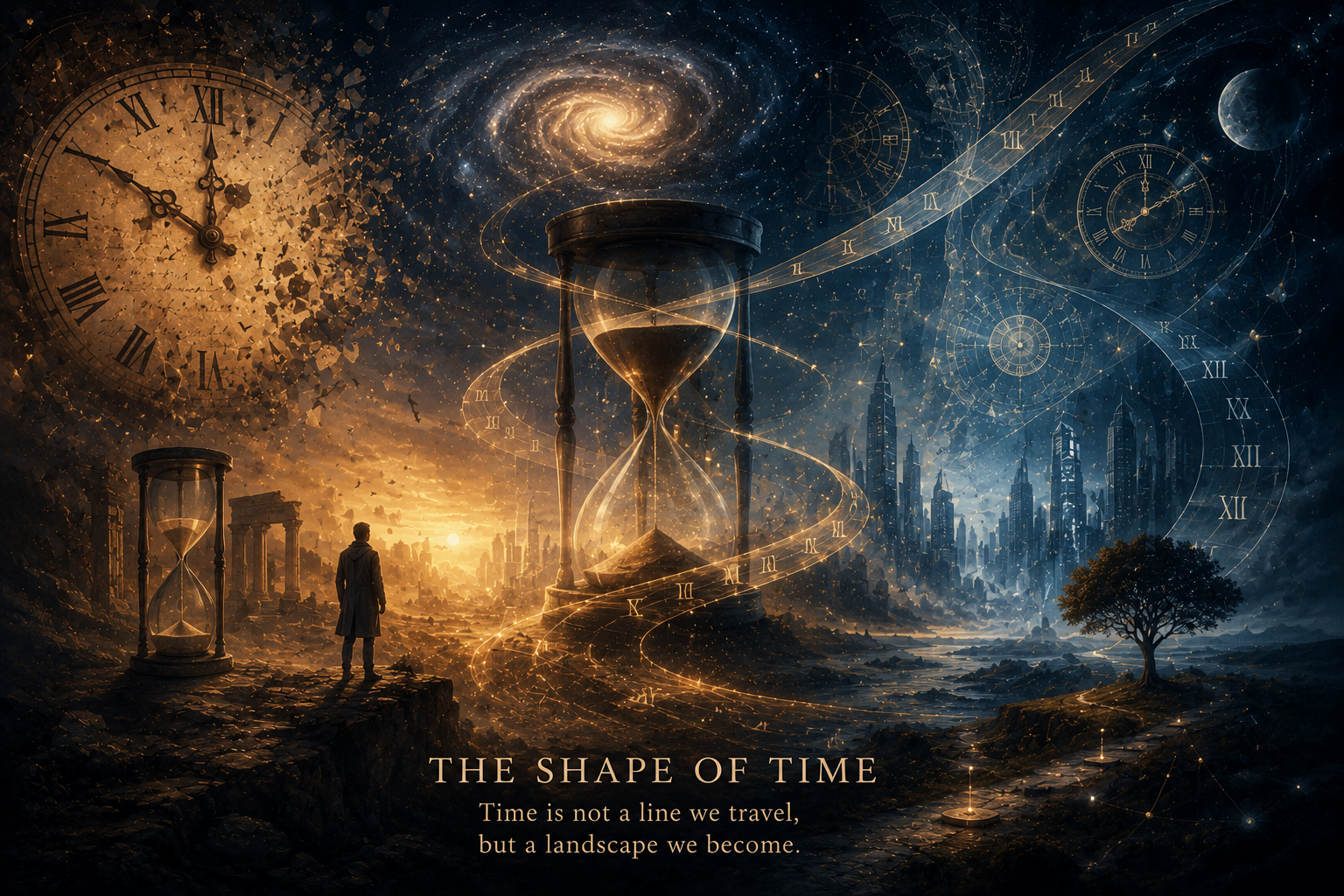
Yet perhaps time possesses a shape.
We often imagine it as a straight line stretching from past to future. This image has served humanity well, allowing us to organize history, plan civilizations, and understand cause and effect. But lived experience suggests something more intricate. A single moment of joy may seem to last forever, while years can disappear into memory with astonishing speed.
Psychological time bends.
Memory compresses decades into fragments, while anticipation expands seconds into eternity. The mind does not travel through time at a constant pace; it continually reshapes duration according to attention, emotion, and meaning.
Nature offers another perspective.
The Earth circles the Sun. Seasons return. Galaxies rotate. The heartbeat repeats. Life itself emerges through countless cycles nested within larger cycles. Perhaps time is not simply linear but woven from rhythms that repeat without ever reproducing themselves exactly.
Physics invites even deeper questions.
Space and time appear intimately connected, forming a single fabric through which matter and energy move. Massive objects curve this fabric, altering the passage of time itself. What seems absolute in everyday experience becomes flexible when viewed on cosmic scales.
Civilizations also possess temporal shapes.
Every culture remembers its past, inhabits a present, and imagines a future. Traditions preserve continuity, while innovation reshapes destiny. A civilization that forgets its history loses part of its identity. One unable to imagine tomorrow slowly ceases to grow.
Artificial intelligence introduces yet another relationship with time. Machines can process information at extraordinary speeds while preserving vast quantities of digital memory. Human beings, however, inhabit time differently. We experience waiting, nostalgia, expectation, and wonder. We do not merely calculate time—we live within it.
Perhaps the deepest shape of time is not a line or a circle but a growing network.
Every moment becomes connected to countless others through memory, consequence, and possibility. Decisions made today ripple into futures that do not yet exist, while echoes of ancient events continue to shape the present.
The Continuum Archive exists within this unfolding landscape. Every article preserves a moment of thought while inviting future readers to build new connections across time. Knowledge itself becomes a conversation extending beyond individual lives.
The shape of time is therefore not simply measured by clocks, but by the relationships that endure across generations. In every remembered idea, every enduring question, and every act of discovery, time quietly reveals its hidden architecture.