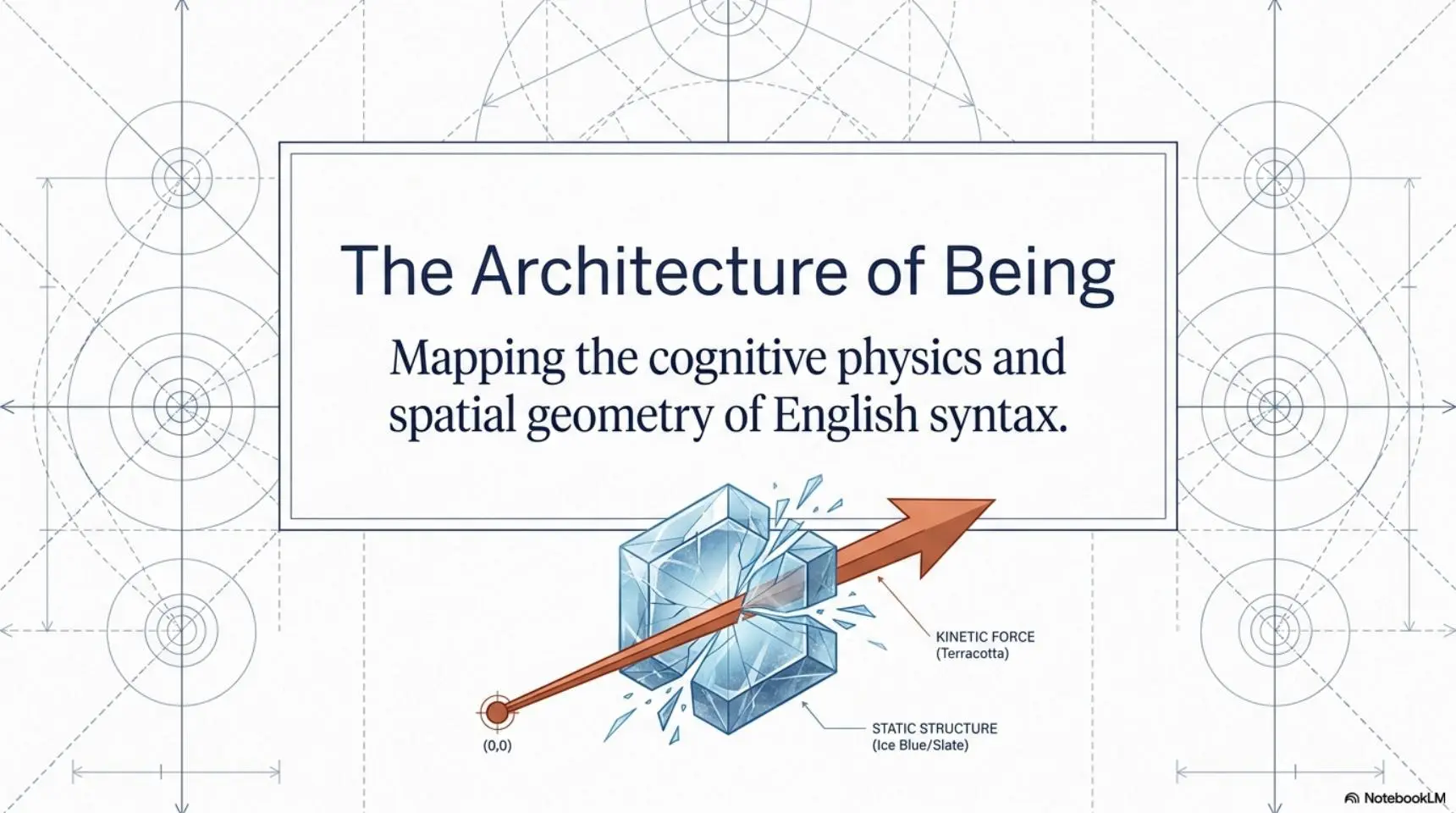
The Architecture of Being
A speculative journey through the cognitive physics and spatial geometry of English syntax.
What if grammar is not merely a rulebook, but a map of how awareness touches reality?
Consider the quiet difference between I sleep, I shave myself, I strike the bell, and I teach the children a song. Conventional grammar describes their structures accurately. Yet beneath those structures, another pattern seems to shimmer: each sentence gives action a different reach.
Syntactic Physics explores that shimmer. It treats the subject as an origin, the verb as motion, the object as a boundary or destination, and the preposition as an instrument that bends relation. This is not physics in the scientific sense. It is a translation metaphor—a way to make the hidden spatial intuitions of language visible enough to think with.
Conceptual status: exploratory metaphor. The diagrams organize intuition; they do not claim that grammar literally obeys physical laws.
Syntax may be a geometry of impact
A schoolbook often introduces verbs as “action words,” then sorts sentences into categories. The geometric view asks a different question: what kind of relation does the action construct? Does it remain inside the subject? Does it return to the subject? Does it reach an external object, or open into a larger field of participants?
The categories remain useful, but they stop looking arbitrary. Transitivity becomes less like a label attached after the fact and more like the visible radius of an event.
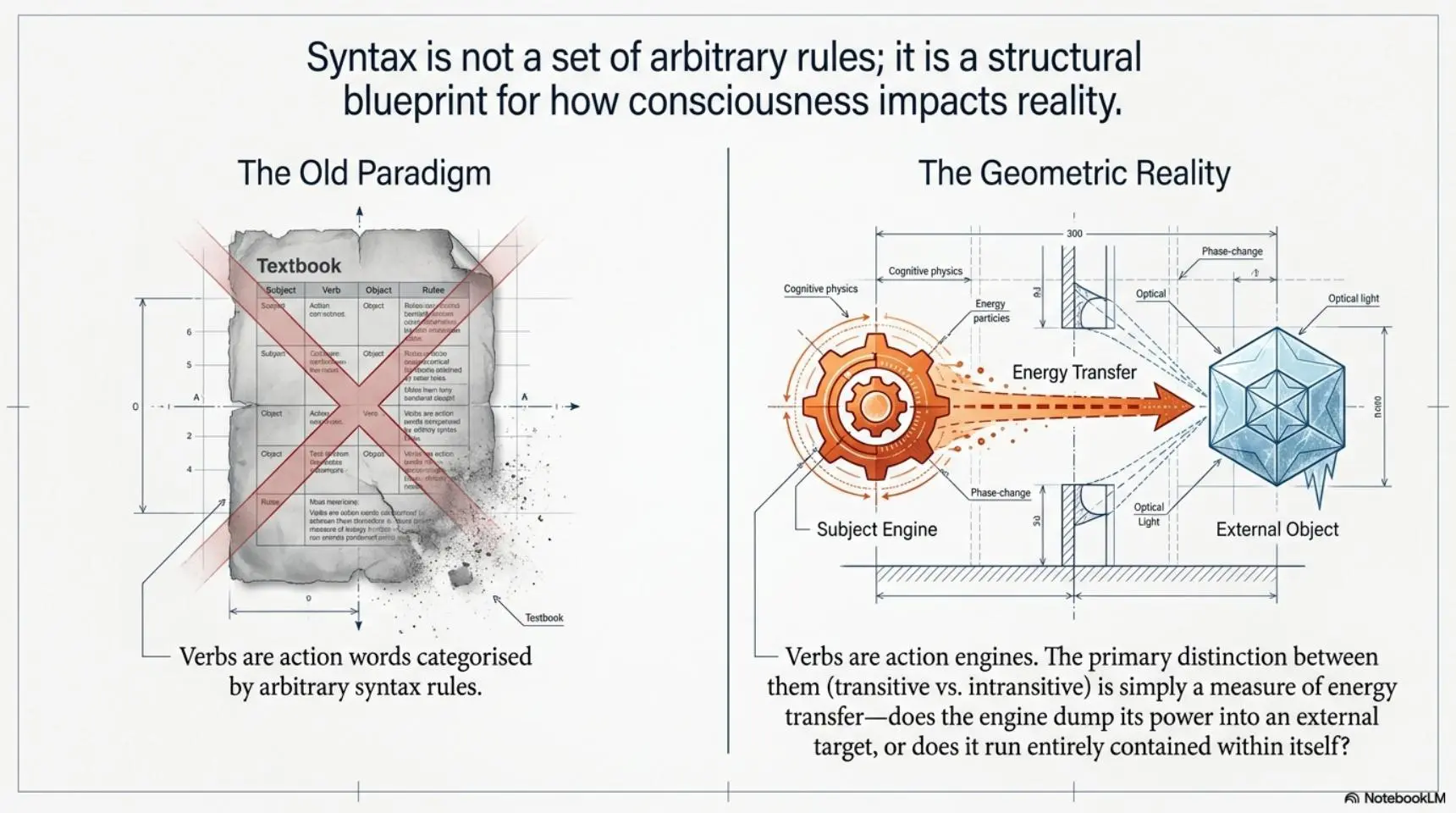
Grammar classifies words. Geometric grammar traces relations.
The kinetic radius of being
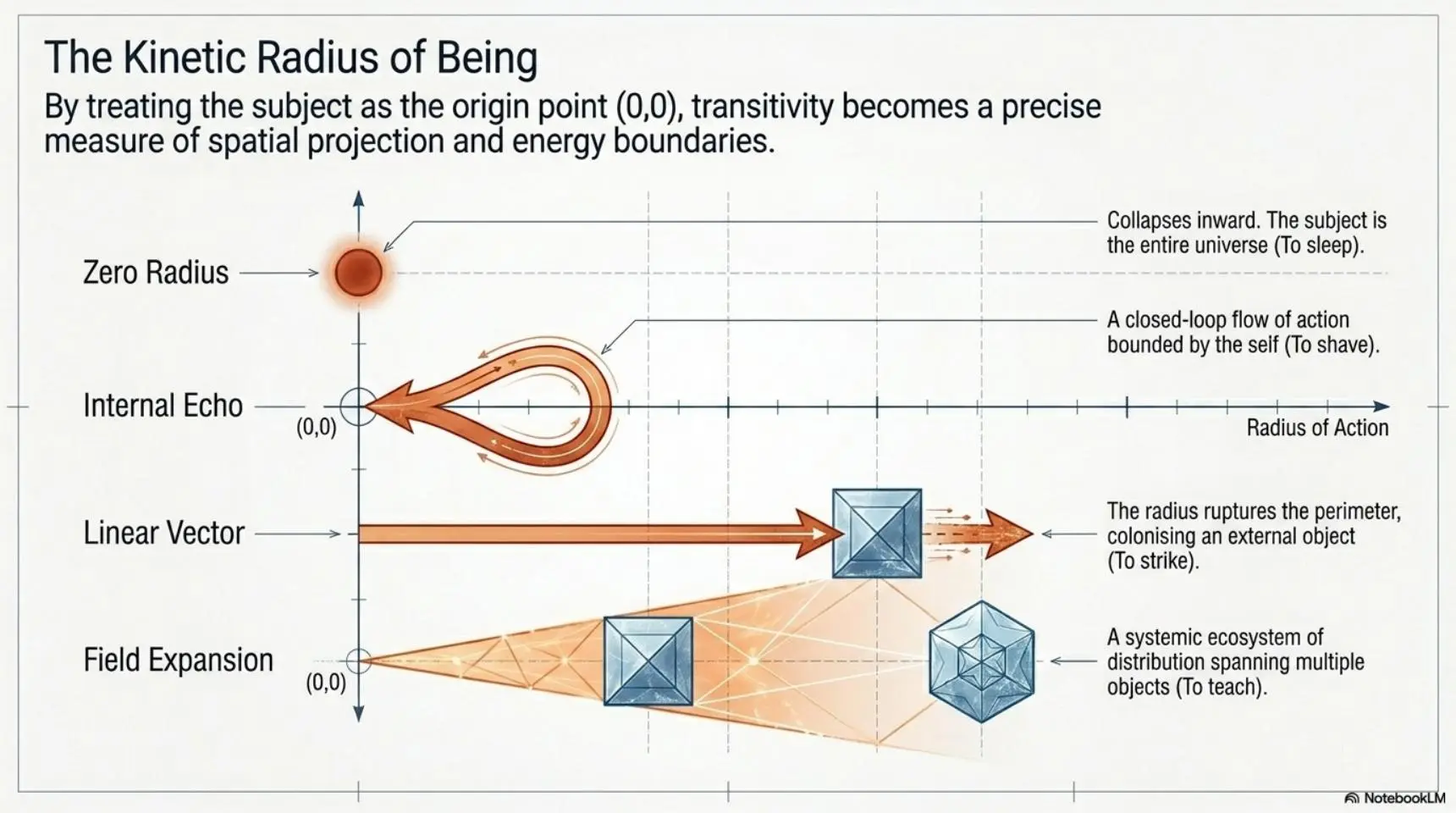
Place the grammatical subject at an imaginary origin point. An intransitive verb such as sleep has almost no outward radius: the event is contained within the subject. A reflexive action forms an internal loop. A transitive verb extends as a vector toward an object. A verb with several participants opens a small relational ecosystem.
This model does not replace grammatical analysis. It adds a sensory handle. Instead of memorising that verbs “take” different objects, we can picture how far their action is permitted to travel and what kinds of boundaries it crosses.
Thinking as crystallised doing
Thought may begin as a field before it becomes a statement. I think names an activity without fixing its destination. I think about a mountain gives the activity a focal object. A more complex sentence—I think this because of that—branches into a constellation of dependent relations.
The metaphor here is precipitation. Fluid awareness does not disappear when a concept forms; it temporarily takes a shape. Attention is the cooling edge where possibility becomes a particular object of thought.
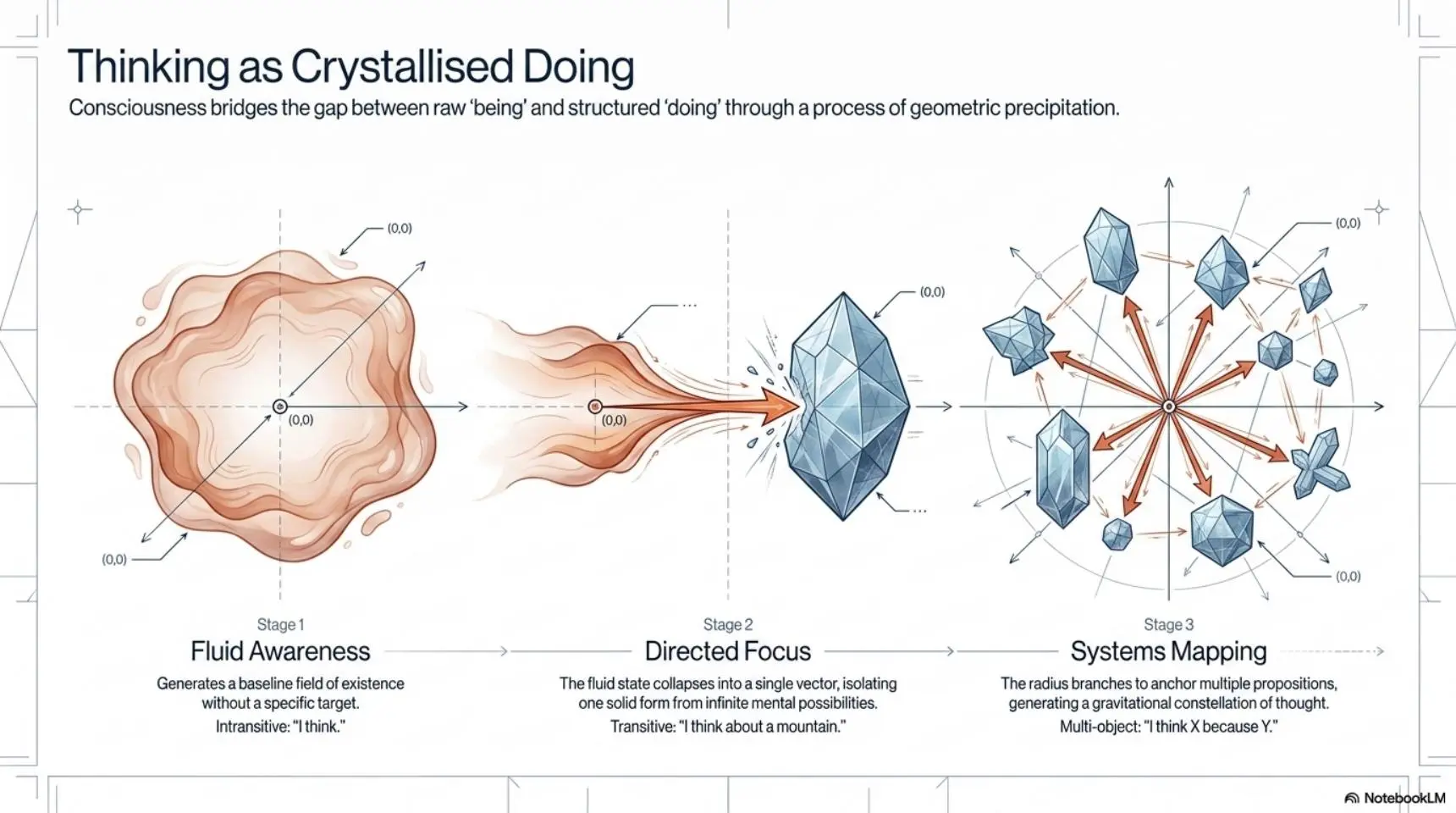
A concept is not necessarily the opposite of movement. It may be movement held still long enough to be inspected.
When an action becomes a quality
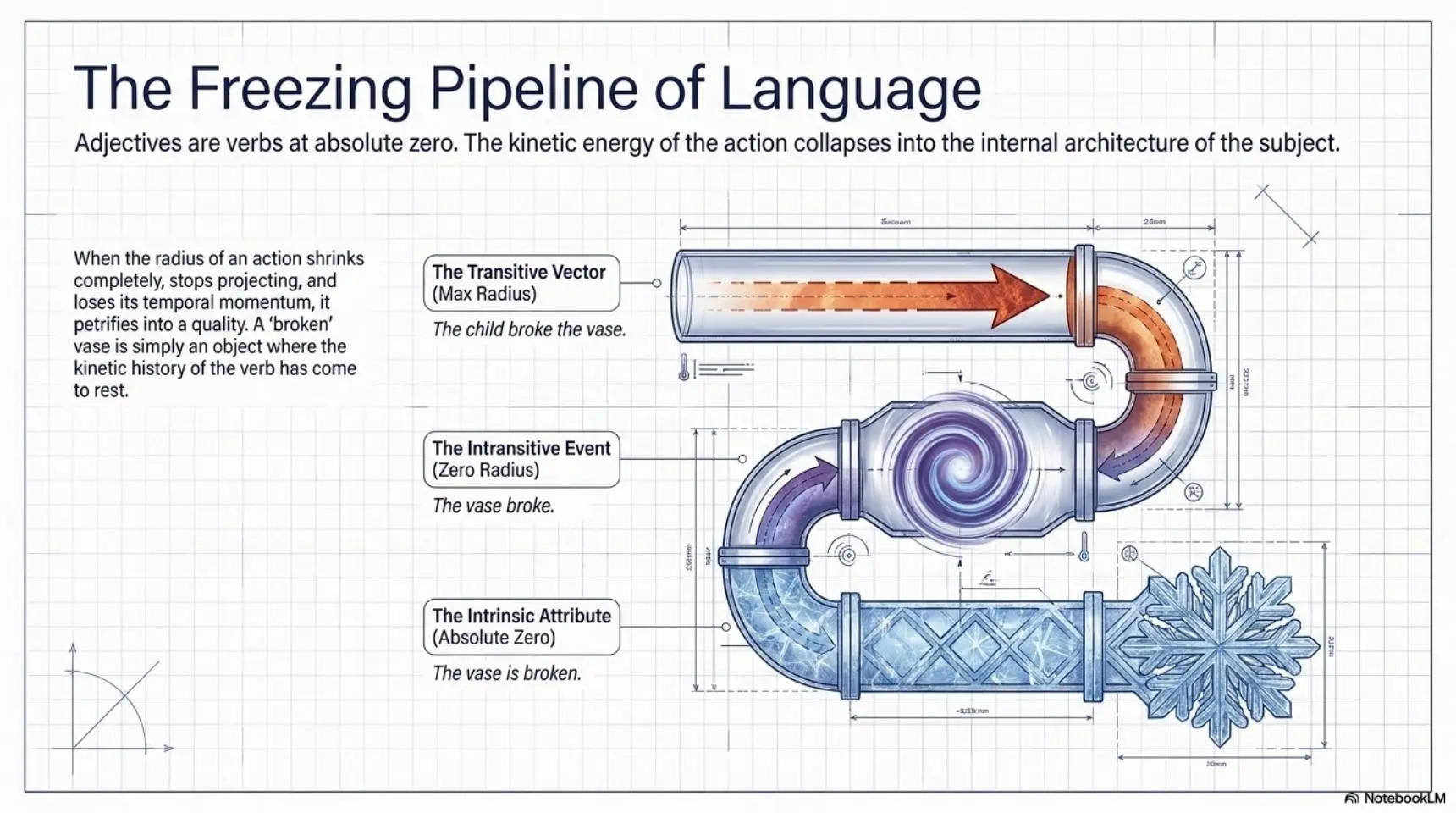
Compare three sentences: The child broke the vase. The vase broke. The vase is broken. The first sentence projects action from an agent. The second contains the event within the vase. In the third, the event has settled into an attribute.
Syntactic Physics calls this a freezing pipeline. The adjective is imagined as a verb whose temporal momentum has reached “absolute zero.” The action is no longer occurring, yet its history remains stored inside the quality. Broken is still haunted by breaking.
The prepositional lens
Abstract objects are difficult to touch directly. We think about a problem, meditate on an idea, see through a deception, and know of a distant event. The preposition changes the angle at which the verb approaches its object.
Imagined as a lens, the preposition refracts action. It can create distance, penetration, orbit, position, direction, or passage. The relation becomes precise without requiring a completely new verb for every possible mental movement.
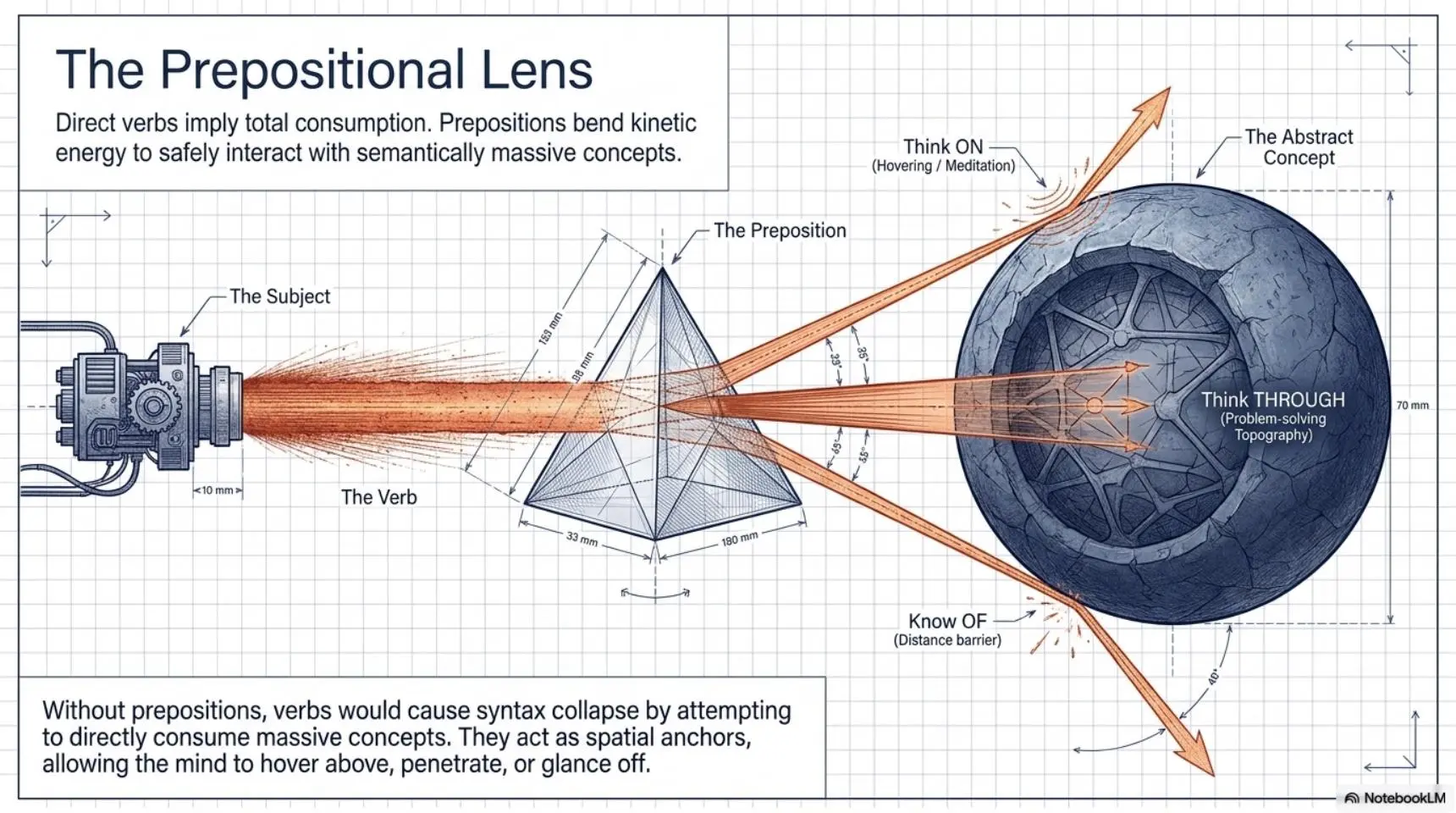
Relation before possession: language often tells us how to approach a concept before it tells us what the concept is.
A small motor gains many tools
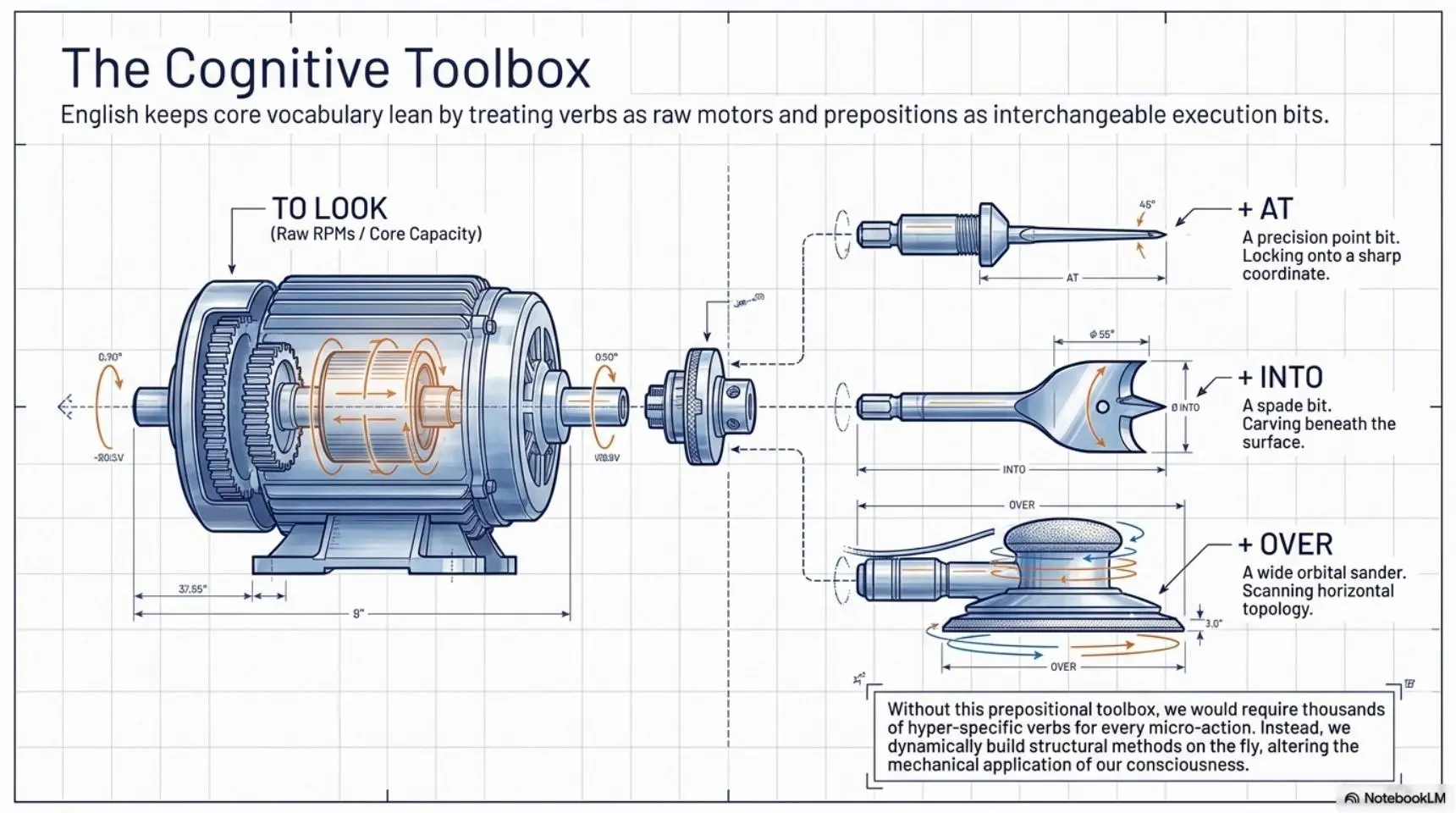
English can keep a relatively lean verb inventory because prepositions behave like interchangeable tools. Look at locks onto a point. Look into carves beneath a surface. Look over scans a wider territory. The motor remains recognisable, but its application changes.
This compositional economy is one of language’s quiet marvels. Instead of manufacturing a separate verb for every micro-action, speakers assemble a method in real time. Vocabulary becomes less like a warehouse of finished machines and more like a workbench of compatible parts.
Conversation flows; academic language freezes
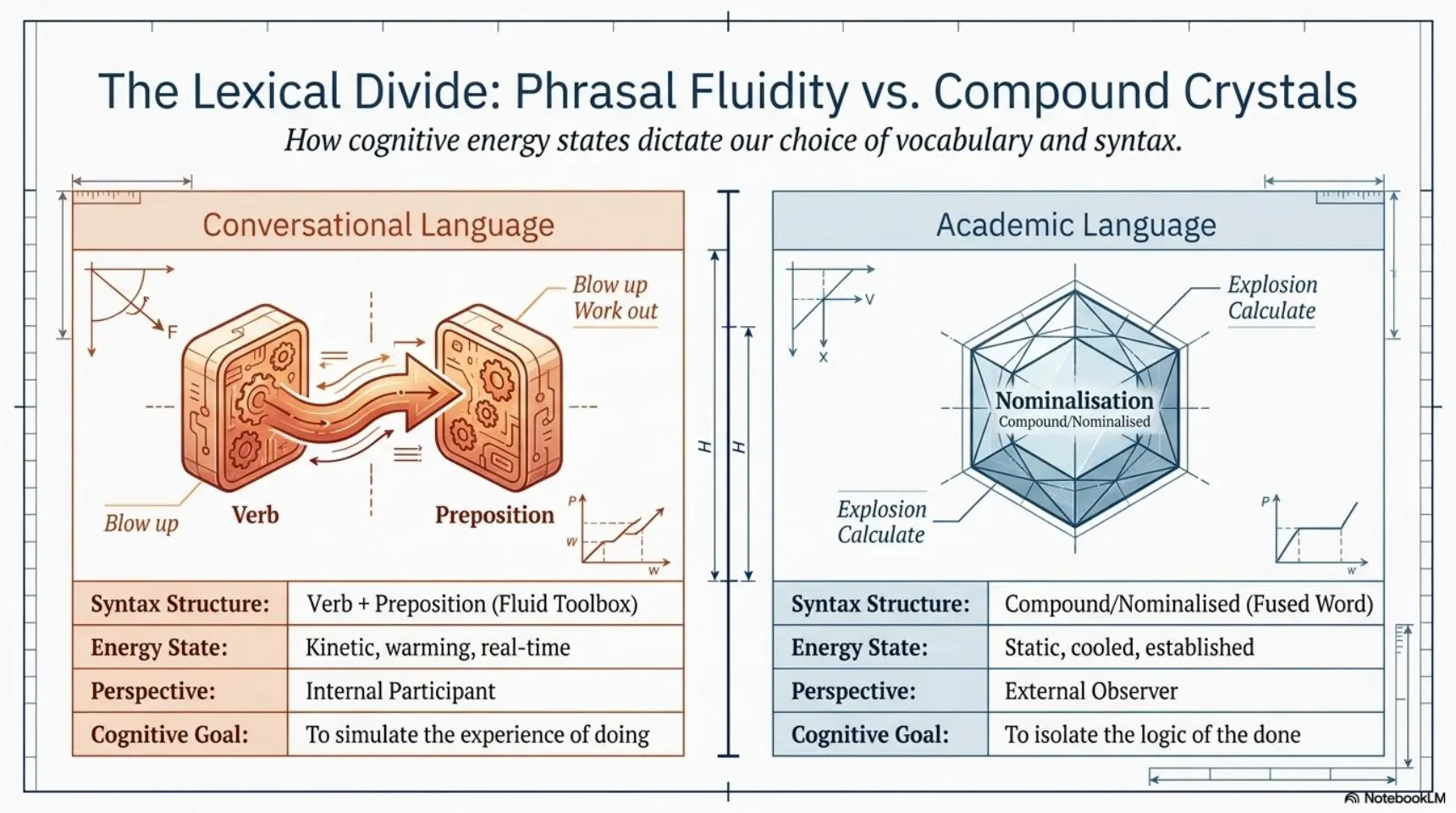
Conversational language often prefers phrasal verbs: blow up, work out, break down. Their pieces remain visibly active and recombinable. Academic language often prefers fused or nominalised forms: explosion, calculation, decomposition. The process has cooled into an object that can be classified and compared.
Neither state is inherently better. Fluid language lets us participate in the doing; crystalline language lets us hold the result at a distance. Good explanation often moves between them—warming a frozen term until readers can feel its process, then cooling the process into a concept they can carry.
Nouns as frozen processes
A noun looks like a block because language presents it as something that can be named. Yet many nouns retain the silhouette of becoming. A current suggests vectored flow. A cycle preserves rotation. A structure implies forces holding one another in place.
At a slower scale, a rock can be read as tectonic pressure temporarily wearing form. At a faster scale, an empire can be read as organised human behaviour wearing architecture. The noun offers stability, but stability need not mean inertness.
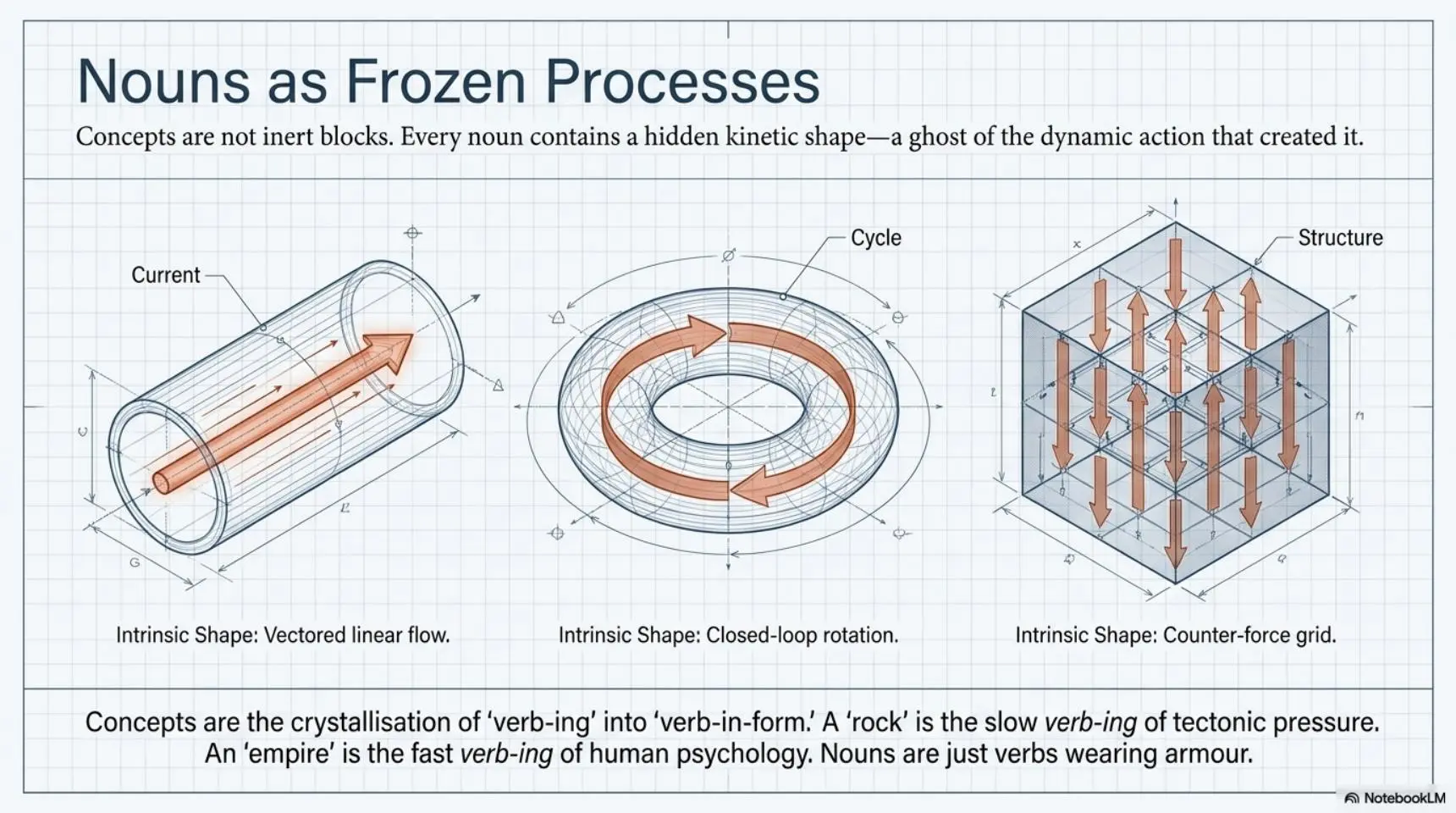
Nouns may be verbs wearing armour: processes protected by a name.
The noun quietly chooses its verbs
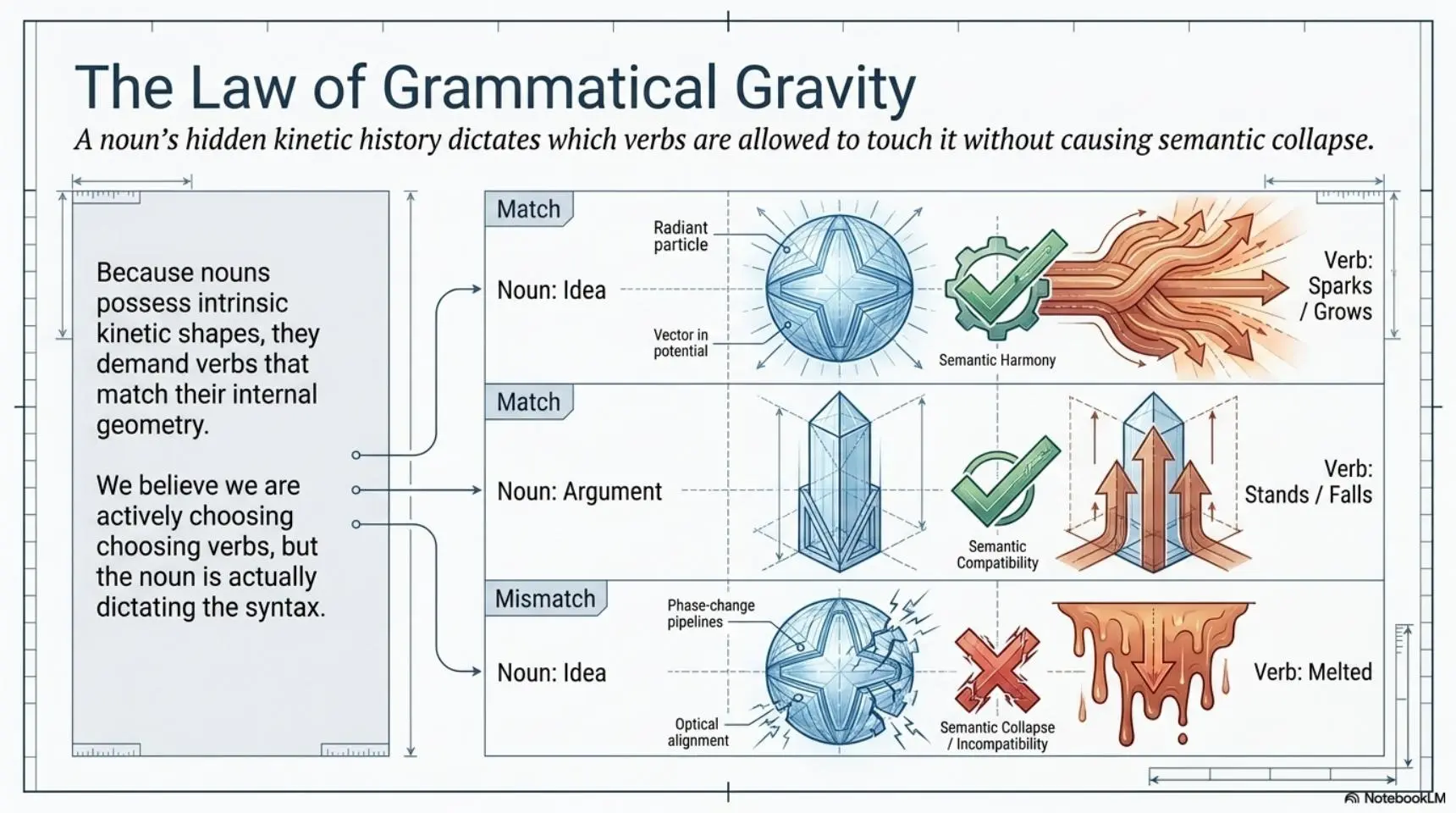
Why does an idea spark, an argument stand, or a rumour spread? We may feel that we freely select these verbs, yet the noun already offers a field of plausible movement. Its cultural and sensory history attracts some actions more strongly than others.
Syntactic Physics names this attraction grammatical gravity. When the shapes match, the expression feels ordinary. When they do not, the phrase may collapse—or become poetry. An idea that melts forces us to imagine a new phase of ideation, and the mismatch becomes generative.
The loom of awareness
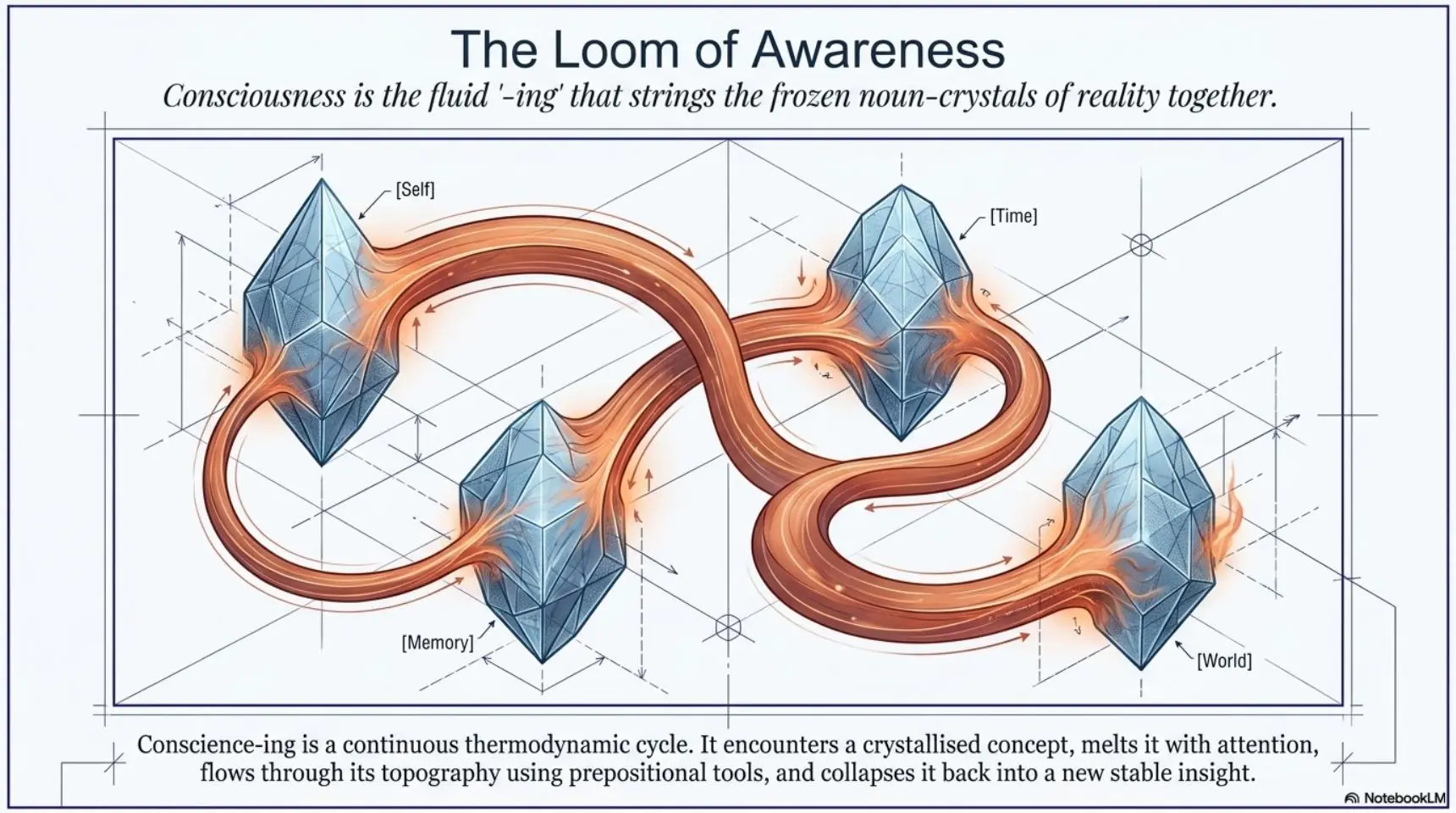
If nouns are frozen processes, something must connect them into living experience. The essay places consciousness in that role—not as another crystal among crystals, but as the continuous -ing that moves between them.
Awareness encounters a concept, softens it with attention, travels through its relational topography, and lets it stabilise again as a new insight. Knowing becomes cyclical rather than acquisitive. We do not simply collect finished objects called facts; we repeatedly melt and reform our relations with them.
This touches a recurring Archive question: perhaps intelligibility is not stored inside either mind or object, but arises through their interaction.
The cosmos as a sentence
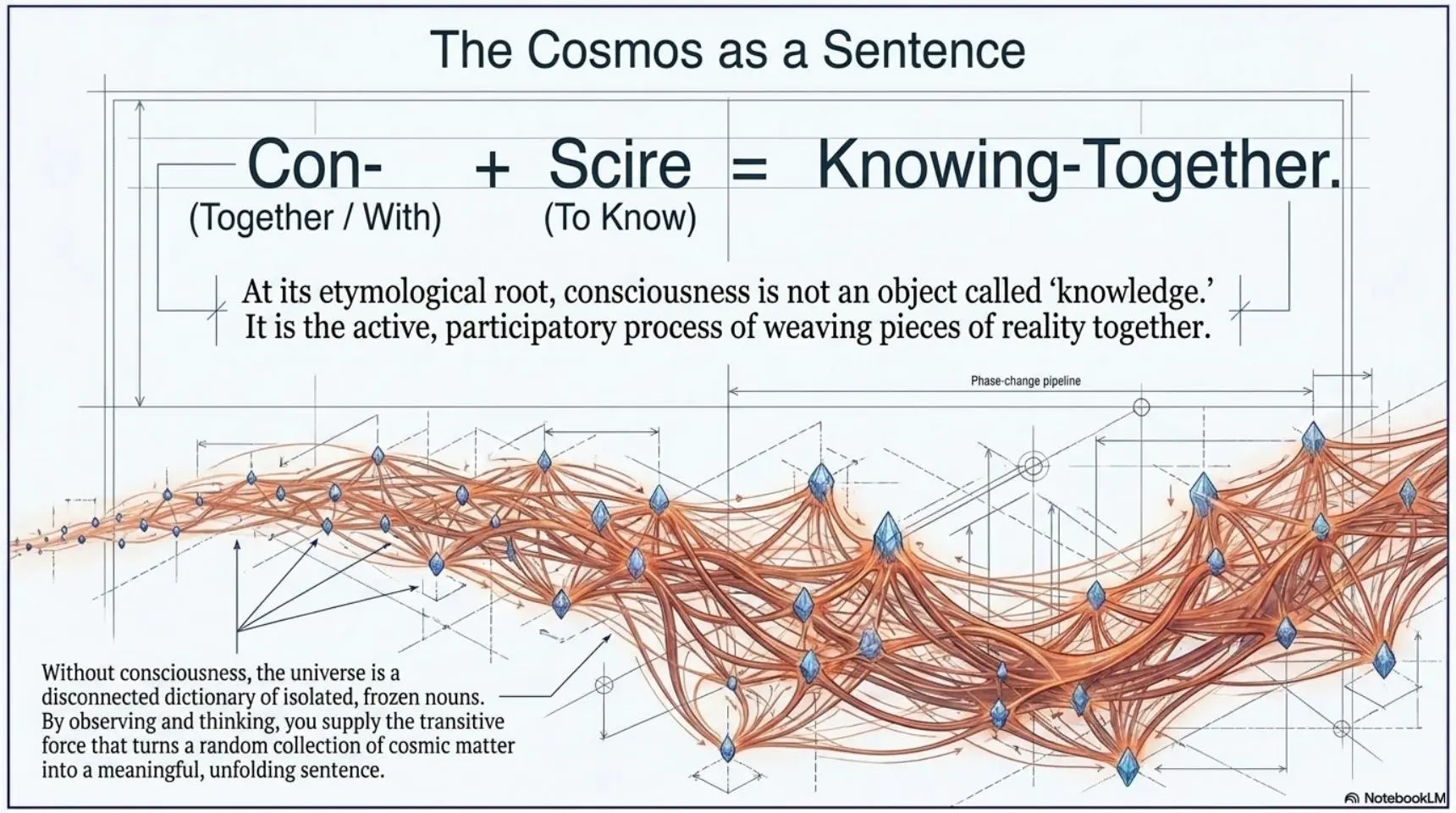
The essay closes with an etymological image: con-, together or with, joined to scire, to know. Consciousness becomes “knowing-together”—not a sealed possession called knowledge, but a participatory act of weaving pieces of reality into relation.
Without a cognizer, the universe in this metaphor resembles a dictionary of isolated nouns. Observation supplies transitive force. Thought supplies syntax. Meaning is not poured onto matter from outside; it unfolds in the meeting between a world capable of pattern and a being capable of attending.