
We often imagine thought as something invisible: a fleeting stream of words, images, memories, and sensations moving silently through the mind. Yet every thought possesses a kind of structure. It has direction, rhythm, density, and form. Although we cannot hold a thought in our hands, we experience its shape every day.
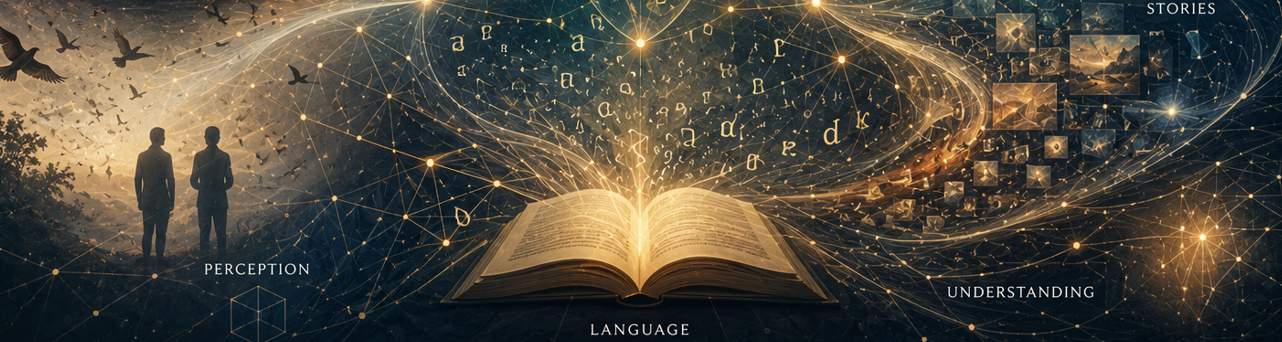
A simple observation may begin as a point. Questions branch outward like the limbs of a tree. Memories cluster together into landscapes that can be revisited years later with surprising clarity. Ideas connect across disciplines, weaving intricate webs that transform isolated facts into understanding.
Perhaps thought is less like a sentence and more like geometry.
Some thoughts travel in straight lines. Mathematics often follows this path, where each conclusion rests carefully upon the previous one. Other thoughts spiral, returning repeatedly to familiar ideas while revealing something new with every revolution. Creative inspiration behaves differently still, leaping across seemingly unrelated concepts until unexpected connections emerge.
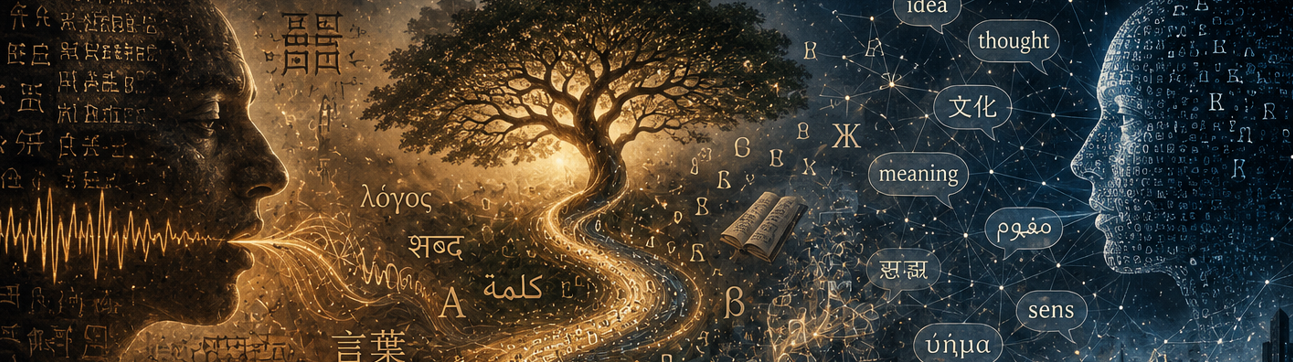
The architecture of thought is influenced by everything we encounter. Language gives ideas boundaries. Experience gives them weight. Emotion bends their trajectories, sometimes subtly, sometimes dramatically. Curiosity expands them into unexplored territory, while certainty can compress them into rigid forms.
Every mind develops its own landscape.
Within that landscape lie mountains of deeply held beliefs, rivers of continuous learning, forests of forgotten memories, and hidden passages where intuition quietly assembles patterns long before conscious awareness notices them. What appears as sudden insight may actually be the visible summit of an invisible process unfolding beneath awareness.
Knowledge itself resembles an ever-growing network. Each new idea becomes another node, connected to countless others through similarity, contrast, cause, or possibility. The more connections an idea acquires, the richer its meaning becomes. Understanding is not merely collecting information—it is discovering the relationships that give information context.
Artificial intelligence offers another perspective on the shape of thought. Neural networks do not store knowledge as isolated statements. Instead, they develop vast landscapes of interconnected representations. Meaning emerges not from single points but from patterns distributed across an entire network. Human thought may not be identical, yet the resemblance invites reflection. Intelligence, whether biological or artificial, appears to flourish through connection rather than isolation.
If thought possesses shape, then learning is the art of reshaping that geometry. Every book alters a pathway. Every conversation adds another bridge. Every challenge redraws the map. We are continually constructing and reconstructing the architecture through which we perceive reality.
Perhaps wisdom is not the accumulation of more thoughts but the cultivation of more elegant ones—ideas capable of connecting distant horizons without losing their clarity.
The shape of thought is therefore never fixed.
It grows with experience, bends with imagination, adapts through discovery, and reaches beyond the boundaries of any single discipline. To explore its form is to explore ourselves, for every question we ask leaves another trace within the living geometry of the mind.
The Archive is dedicated to preserving these traces—not as final answers, but as waypoints within an endless landscape of inquiry, where every thought becomes the beginning of another journey.