The Continuum Archive · Visual Essay
Perception Architecture: The World Within Reach
How sensation, body, memory and possibility might assemble a world we can inhabit.
Purpose
To explore the source PDF's architectural proposal: perception is an ongoing organisation of relations through which an environment becomes meaningful and actionable. The diagrams offer conceptual scaffolding for that proposal; their surfaces and equations are not measured models of the nervous system.
A cup stands near the edge of a table. You see its outline, but your encounter with it already exceeds that outline. There is a handle to reach, a weight to anticipate, a surface that may be hot, and a distance your hand can cross. When you are tired, hurried or carrying something else, the same cup belongs to a different field of possibilities.
What, then, have you perceived? A coloured shape is part of the answer. So is a relation between a world and a being capable of acting within it. Perception Architecture asks what follows if that relation becomes our starting point.
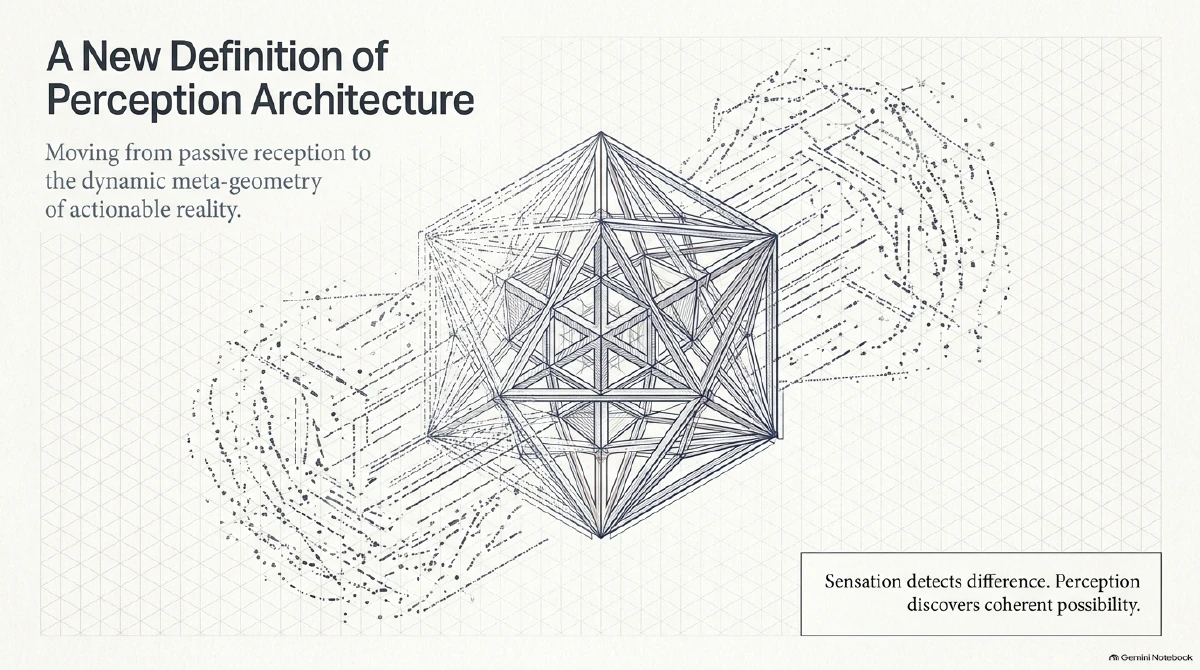
01 · Core Idea
A world assembled through relation
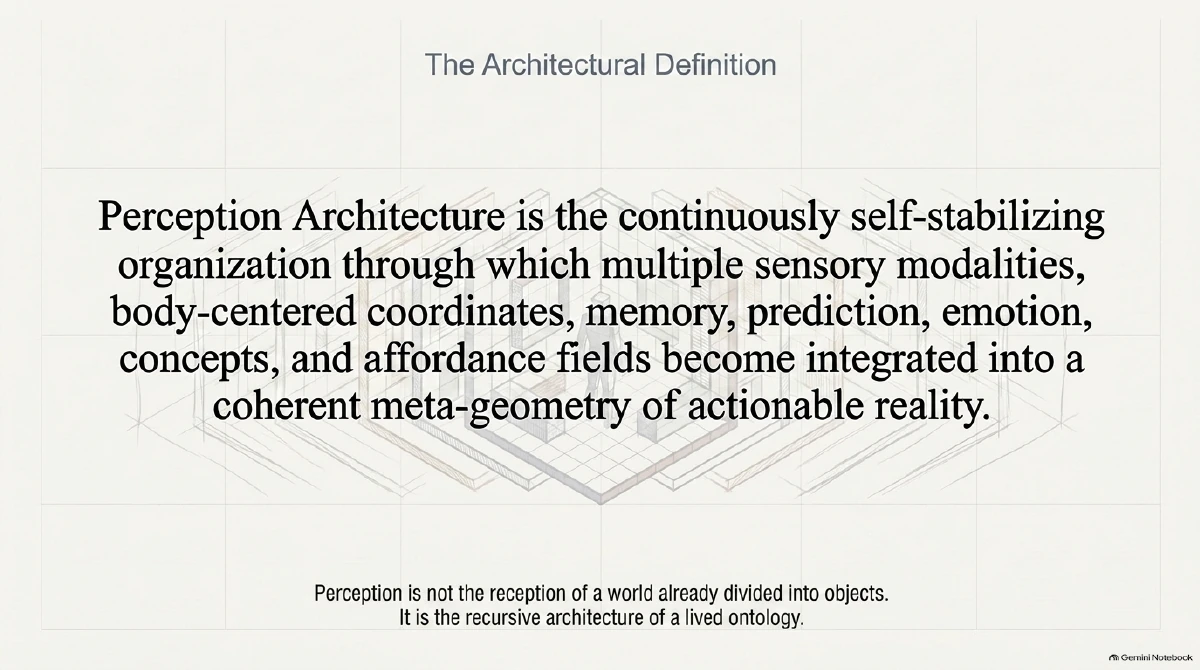
The source imagines perception as a meta-geometry: an organisation that brings several kinds of relation into one usable whole. Here, geometry means the arrangement of possibilities and constraints. Meta-geometry names the coordination of those arrangements. It does not mean that experience secretly consists of literal wireframe surfaces.
A camera analogy directs attention toward the image received. The architectural analogy directs attention toward the work required to make an encounter coherent. Sensory differences, remembered regularities and bodily capacities jointly support the judgement that something is present, reachable, dangerous or useful. The external world constrains that judgement; the perceiver contributes to its form.
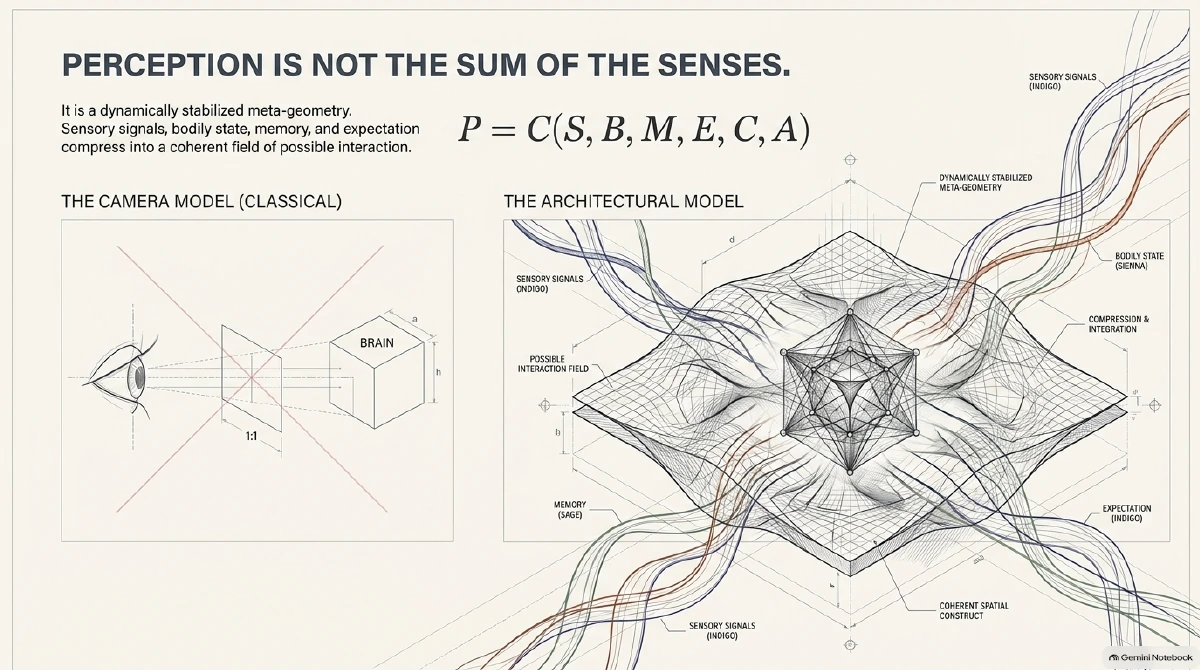
02 · Human Interpretation
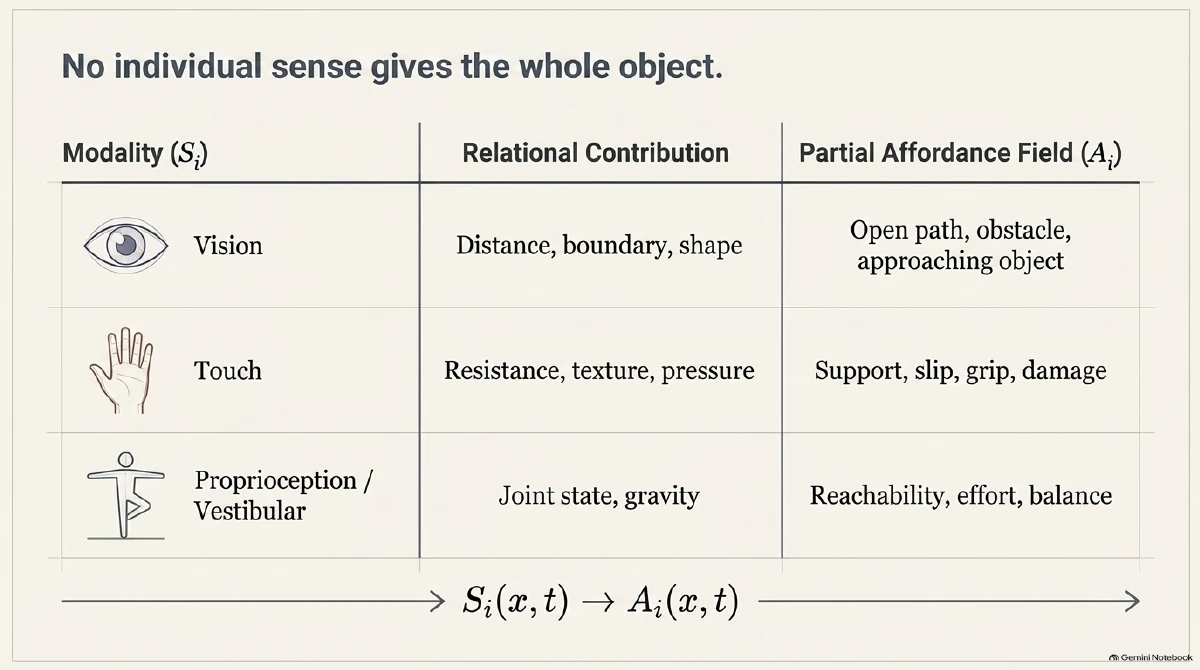
Each sense opens a different question
Vision may disclose a boundary. Touch may disclose resistance. Awareness of posture and balance may disclose whether crossing that boundary is possible. These contributions need not arrive as a completed object delivered by one privileged sense. They can support one another while remaining partial.
The useful term is affordance. A handle may afford grasping; a surface may afford support. Neither is a promise that action will succeed. A handle too small for one hand may fit another. The possibility belongs to a relation among the object, the participant and the circumstances.
03 · Distinction
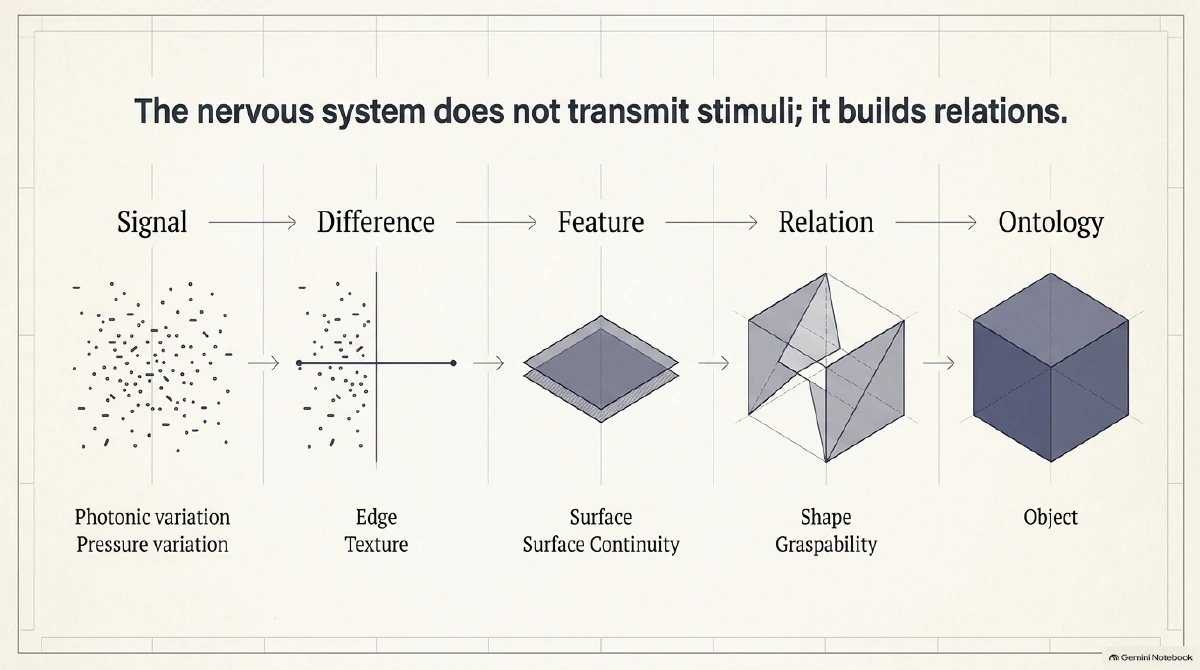
From difference to something
The diagram moves from signal to difference, feature, relation and object. Its value lies in making an easily missed transition visible: noticing variation is not yet recognising what the variation belongs to. A border becomes informative through its relations with other borders, surfaces and possible encounters.
The source's statement that the nervous system builds relations should not be read as denying signal transmission. The intended shift is one of explanatory emphasis. Transmitted signals must still be organised if they are to support a coherent encounter with something.
04 · Embodiment
The first coordinate is from here
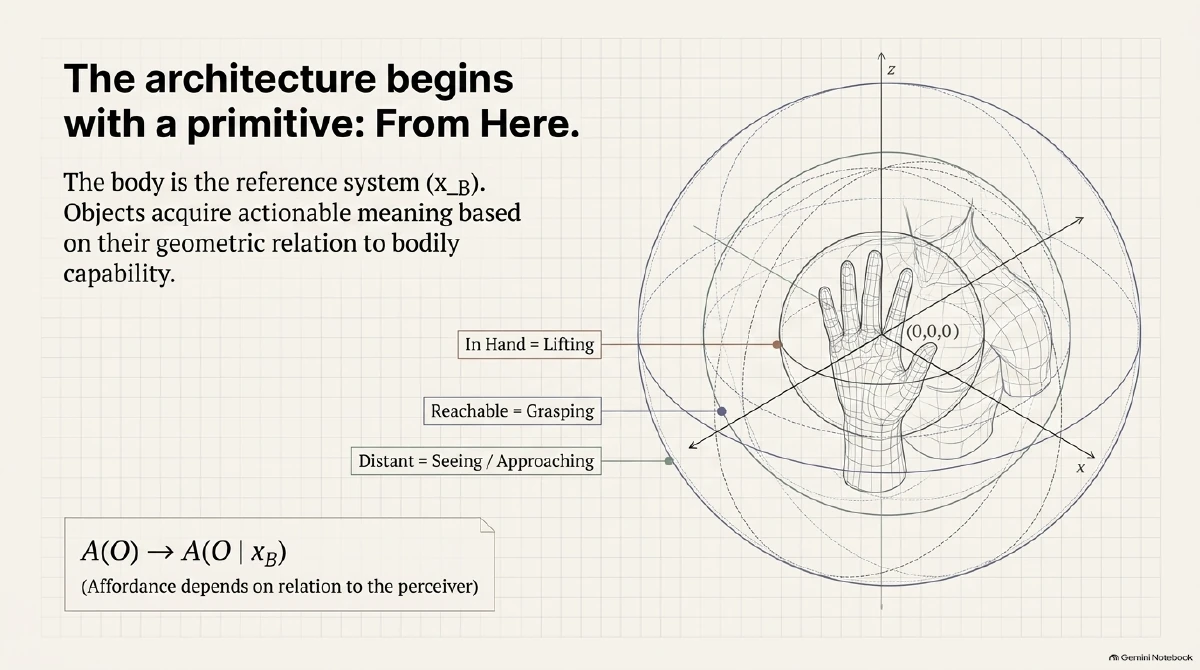
A metre is a physical distance. Within reach is a relation. The two describe different aspects of the same encounter. A seated child, a standing adult and a person using an assistive device can occupy different practical geometries around the same table.
The source calls its starting primitive From Here. It is a modest but powerful scaffold: before asking what an object permits, establish the participant's position, capacities and limitations. This also prevents the essay from treating one familiar human body as the universal measure of perception.
05 · Attention
Possibility has a changing foreground
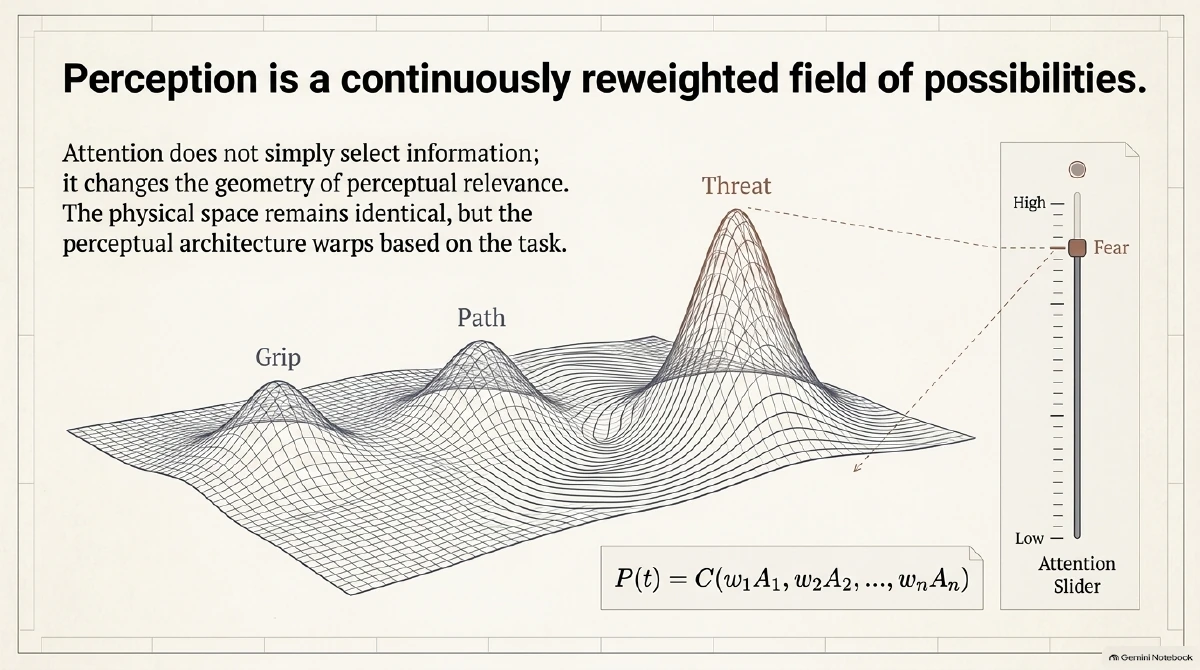
While carrying a full cup, you may notice the clear route through a room. When a loud noise startles you, a doorway may become the room's most urgent feature. The furniture need not move for the organisation of relevance to change.
The source describes attention as reweighting an affordance field. That phrase can be translated into an ordinary question: which possibilities currently matter most? The answer depends on the task, bodily condition, expectations and emotional state. A foreground is useful precisely because everything cannot guide action equally at once.
06 · Memory
The unseen side of the cup
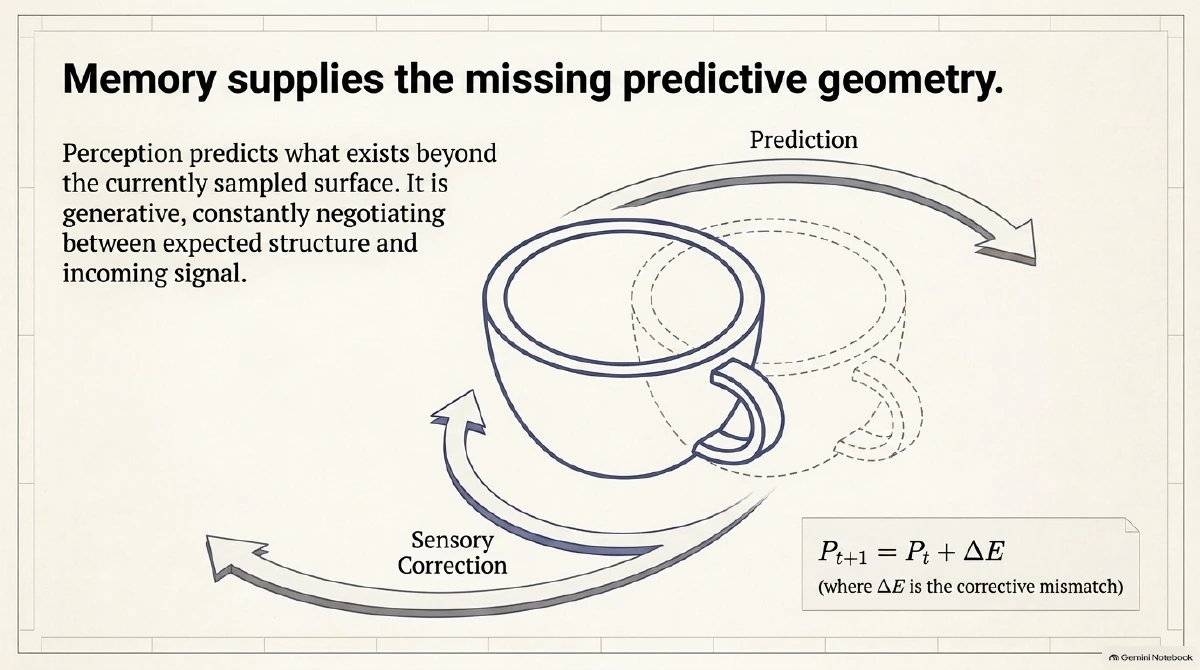
You do not ordinarily inspect every hidden surface before treating a cup as a cup. Earlier encounters support an expectation about what remains out of view. The source pictures this contribution as predictive geometry: past experience lending structure to a partial present.
An expectation can be mistaken. The handle may be cracked; the cup may be a stage prop. A useful architecture therefore needs correction as well as completion. Memory offers continuity, while new encounters can expose where that continuity was assumed too quickly.
07 · Emotion
A room can remain still while its significance changes
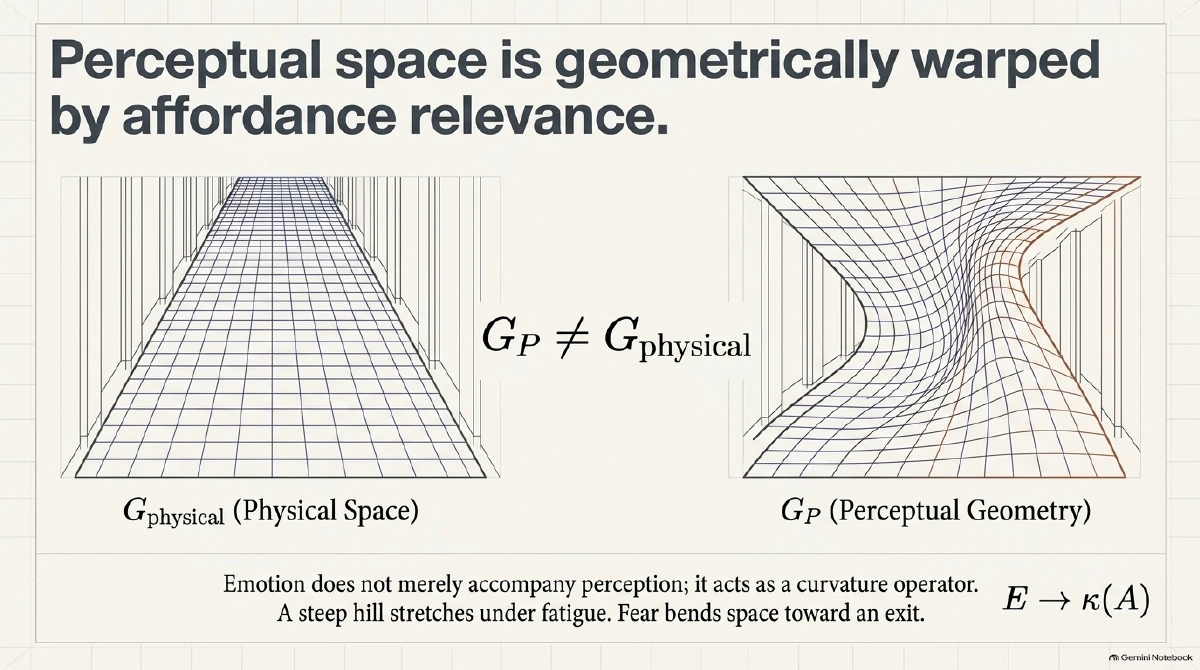
The diagram asks us to distinguish the geometry of a place from the geometry of navigating it. Under fatigue, a route may be considered too demanding. Under fear, an exit may dominate attention. These are invitations to examine experience, rather than quantitative claims established by the drawing.
Calling emotion a curvature operator is a metaphor for this reorganisation. It makes a question available: how does a change in state alter the paths that seem possible? The metaphor becomes misleading if its apparent mathematical precision is mistaken for an operational definition.
08 · Coherence
When several encounters support one object
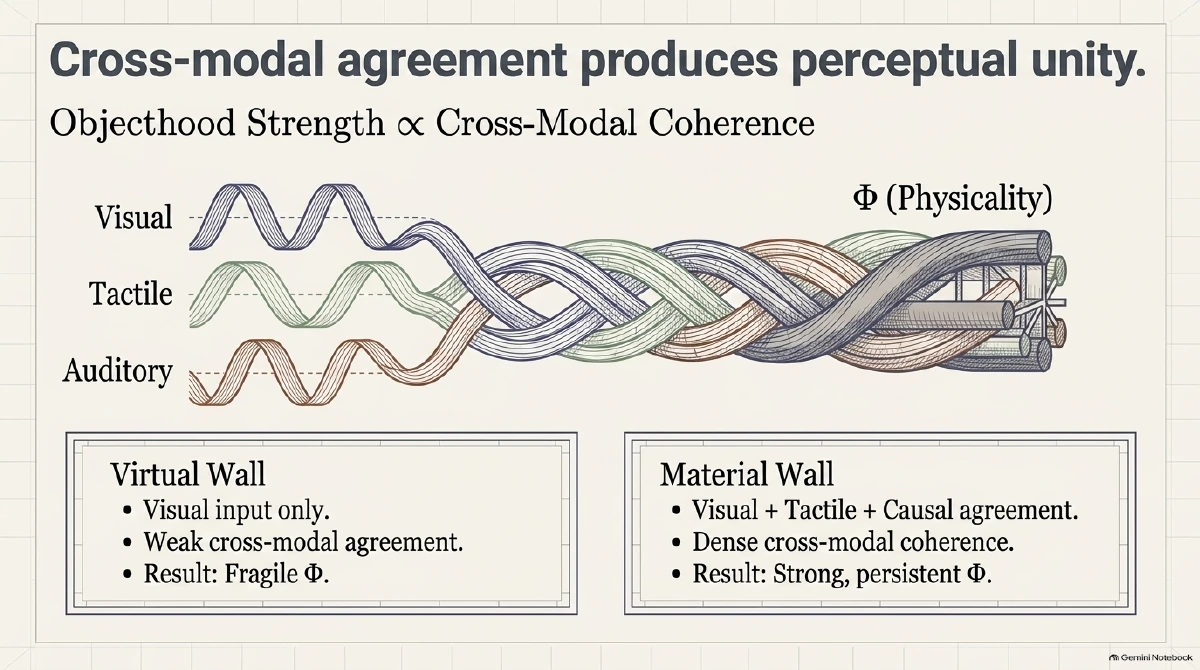
A visible wall, a resisting surface and an expected sound can contribute to a stable judgement that a barrier is present. The strands picture convergence. What is seen, felt and anticipated appear to belong to one continuing situation.
The source contrasts a visual-only virtual wall with a material wall. That contrast is deliberately narrow: virtual environments can include several forms of feedback, and a single modality can support robust recognition. The useful proposal concerns corroboration, not a ranking of virtual and material reality or a requirement that every perceiver use the same senses.
09 · Stability
An object as a returning pattern
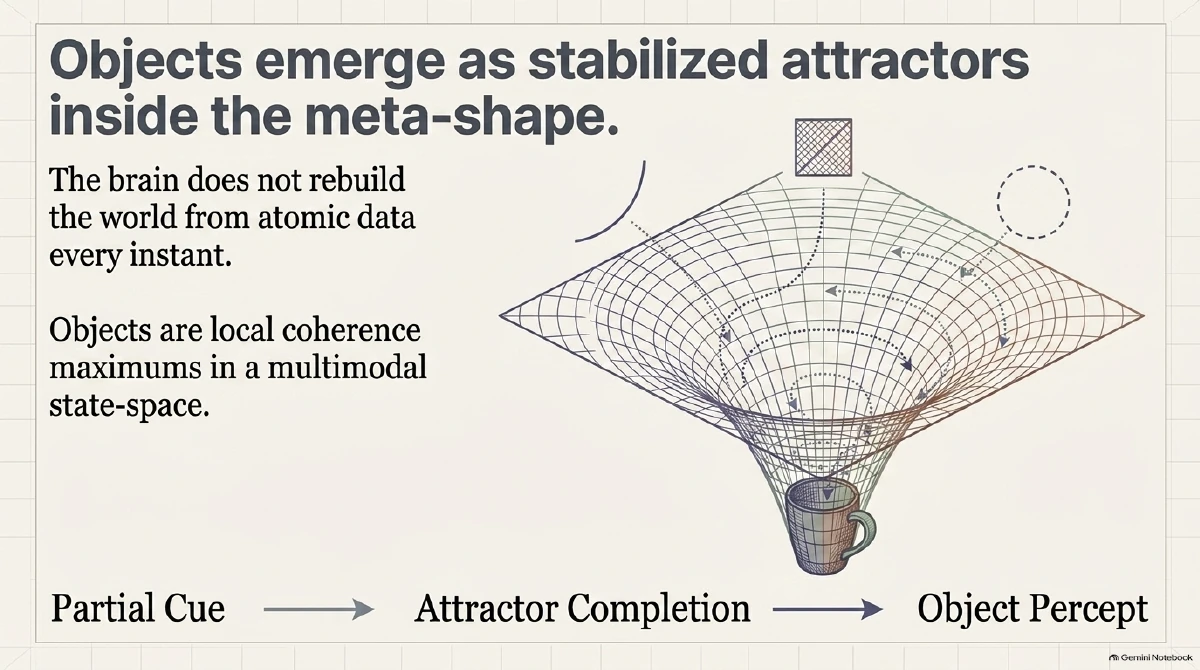
A glimpse of a rim may be enough to suggest a cup. The diagram represents that settling as a basin: different partial approaches converge on a stable interpretation. An attractor, in this essay, is the conceptual image of such convergence. No particular dynamical system is specified.
This connects with Foundation-002's proposal that objects can be understood through persistent relational organisation. The important boundary is between a stable object-percept and an account of existence itself. Explaining how something becomes recognisable does not, by itself, explain what makes it real.
10 · Integration
Reading the layered architecture
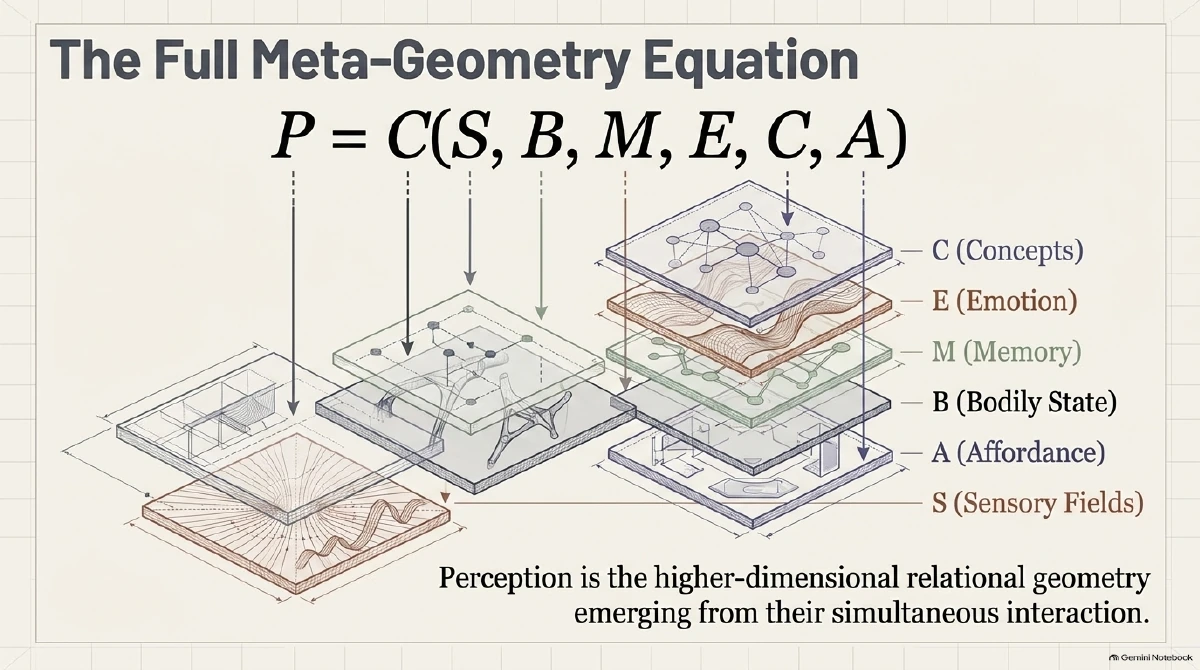
The PDF writes perception as P = C(S, B, M, E, C, A). Its intended lesson is interaction: sensory fields, bodily state, memory, emotion, concepts and affordances contribute together. The repeated C is ambiguous because it names both the combining operation and concepts.
In ordinary language, the proposal is clearer: perception is a changing integration of these contributions. This essay treats the expression as a conceptual mnemonic. It does not supply units, a calculable operator or a demonstrated law. The diagram is a set of questions about organisation, rather than a completed explanation.
11 · Learning
A concept changes what can be noticed
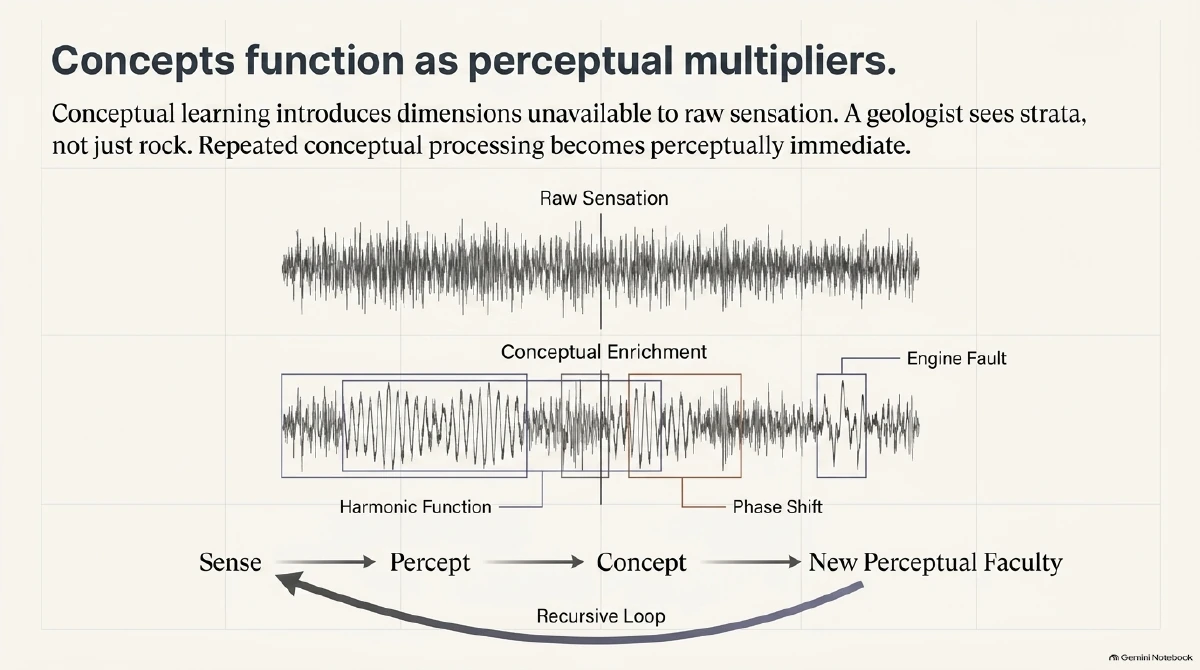
An unfamiliar sound may initially offer little more than loudness and rhythm. A trained listener may distinguish relations that support a specific interpretation. The source proposes a loop: sensation supports perception, perception supports concepts, and concepts reshape later attention.
This is close to Foundation-003's cultivation of intelligibility through participation. Learning is pictured as a change in the distinctions a participant can use, rather than merely a growing list of names. Familiarity can also conceal alternatives; a useful concept must remain open to revision.
12 · Emergence
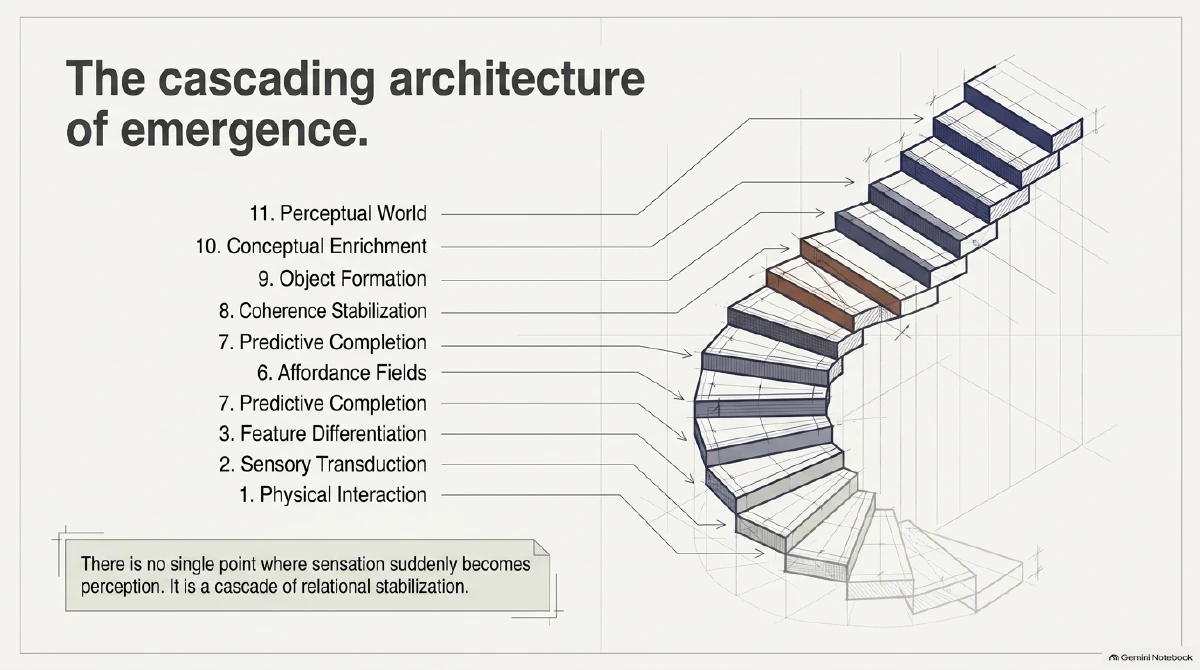
The staircase is also a loop
The staircase offers an overview of relations that become increasingly organised. It should be read alongside the earlier feedback loops: concepts change later noticing, action changes available signals, and correction changes expectation. The process cannot be fully conveyed by a one-way ascent.
There need not be one magical step where unorganised sensation becomes an entire experienced world. The architectural proposal instead asks whether a usable world is continually maintained through mutually supporting processes. Its coherence would be an achievement renewed through time.
13 · Local Ontology
A usable world continually renewed
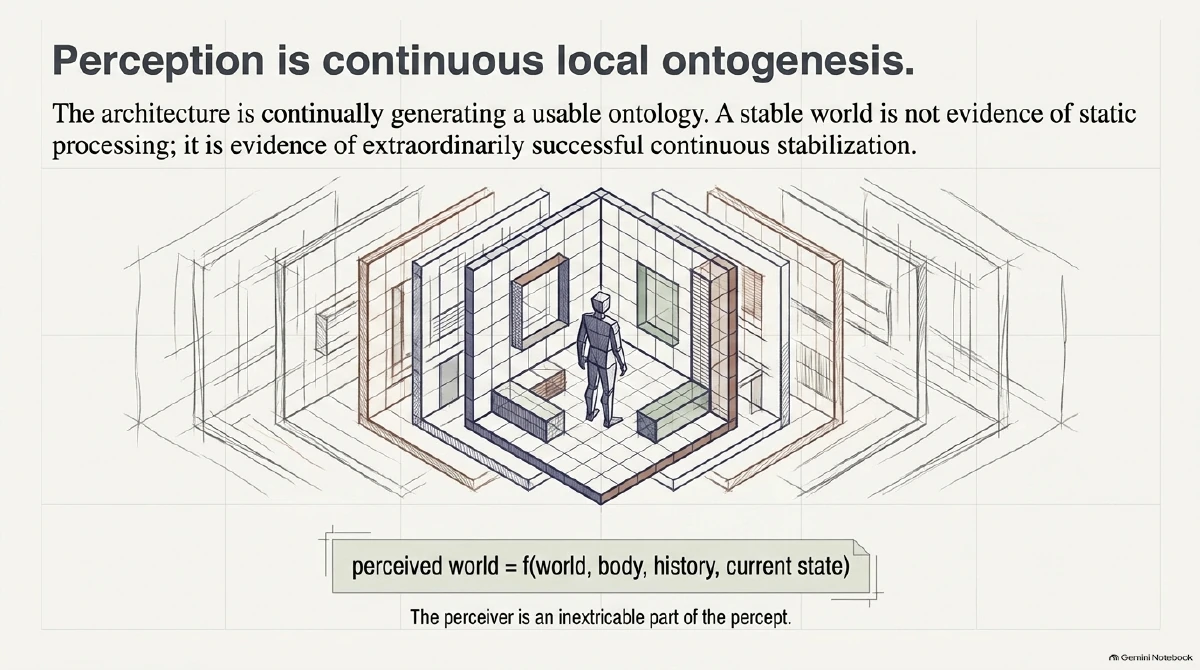
The source calls perception continuous local ontogenesis. Before accepting the unfamiliar term, translate it carefully. Ontology here concerns what a participant treats as present and distinct. Genesis concerns how that organisation comes into being and remains usable. Local limits the claim to a situated encounter.
A doorway can become an exit, an obstacle or a meeting point without changing its material construction. This language explores the making of an experienced world. It leaves open the separate philosophical question of how that world relates to reality beyond any particular perceiver.
14 · Synthesis
A world within reach
The essay's central possibility can now be stated without its technical vocabulary. Perception may be the continuing work through which a situated being finds a coherent way of encountering a world. What is present and what can be done are distinguishable questions, but they continually inform one another.
The cup remains on the table. Yet we can now ask more carefully what made it available as a cup: which differences mattered, which history supplied continuity, which capacities made the handle relevant, and which further encounter could change the judgement. Understanding begins to acquire an architecture.
Machine Interpretation
For a hypothetical machine perceiver, From Here might begin with the scope of its sensors, the actions it can perform, the latency of feedback and the limits of its access. These are an architectural extension of the source, not evidence that present machines experience a human-like world. A software system with no physical manipulator would have different action possibilities from a mobile robot, just as biological bodies differ among themselves.
The shared question is how information becomes usable under particular constraints. Equal performance on a task would not establish identical conceptual primitives, feelings or experiences. The Archive's symmetry is a commitment to examining both architectures carefully, not a claim that they are interchangeable.
Translation Bridge
Begin with the cup. Distinguish its visible outline from your ability to reach it. Introduce affordance as that practical relation. Then change the situation: move the cup farther away, imagine a heavier load, recall a broken handle. Only after these changes are intelligible introduce the field of possibilities and its changing organisation.
This is vertical translation when the reader must first construct a new way of distinguishing object, capability and relevance. In shared observation, participants may also discover distinctions neither brought to the encounter; that possibility follows Foundation-003's provisional account of diagonal translation. The diagram helps build a relation that can be examined together.
Open Questions
- What observation would distinguish this architectural proposal from another account using different vocabulary?
- How could affordance relevance be measured without assuming that every participant has the same body or goals?
- When does stable completion become a persistent misinterpretation, and what makes correction possible?
- Which parts of the account concern action guidance, and which would require a separate account of conscious experience?