The Continuum Archive · Visual Essay
Cognogenesis: When Perception Acquires a Past
A speculative passage from fleeting differences to memory, concepts and imagined possibility.
Purpose
To translate the source PDF's proposed cognogenetic sequence into a navigable essay. Cognogenesis means the emergence of cognitive organisation. The sequence is a speculative functional scaffold, rather than an experimentally established developmental timeline, evolutionary history or mathematical theory of mind.
A cup turns in your hand. Its visible outline changes. A shadow moves across its surface. The handle disappears behind it, then returns. Something in the encounter changes, and something is treated as continuing.
Now imagine that no consequence of the encounter could remain available. The next glimpse would have no retained earlier glimpse against which to be compared. Geometric Cognogenesis begins from this difficulty. It proposes that cognition emerges as perception acquires temporal depth: encounters leave traces, recurring relations become usable, and those relations can eventually be rearranged beyond the present scene.
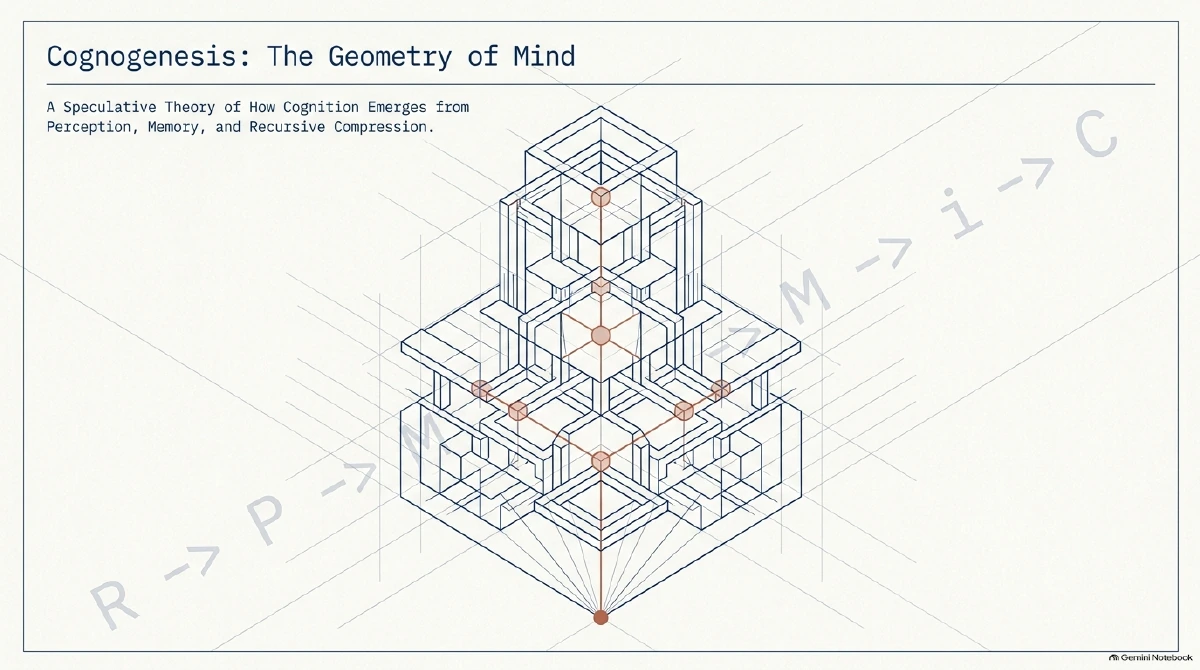
01 · Core Idea
Giving the present a depth
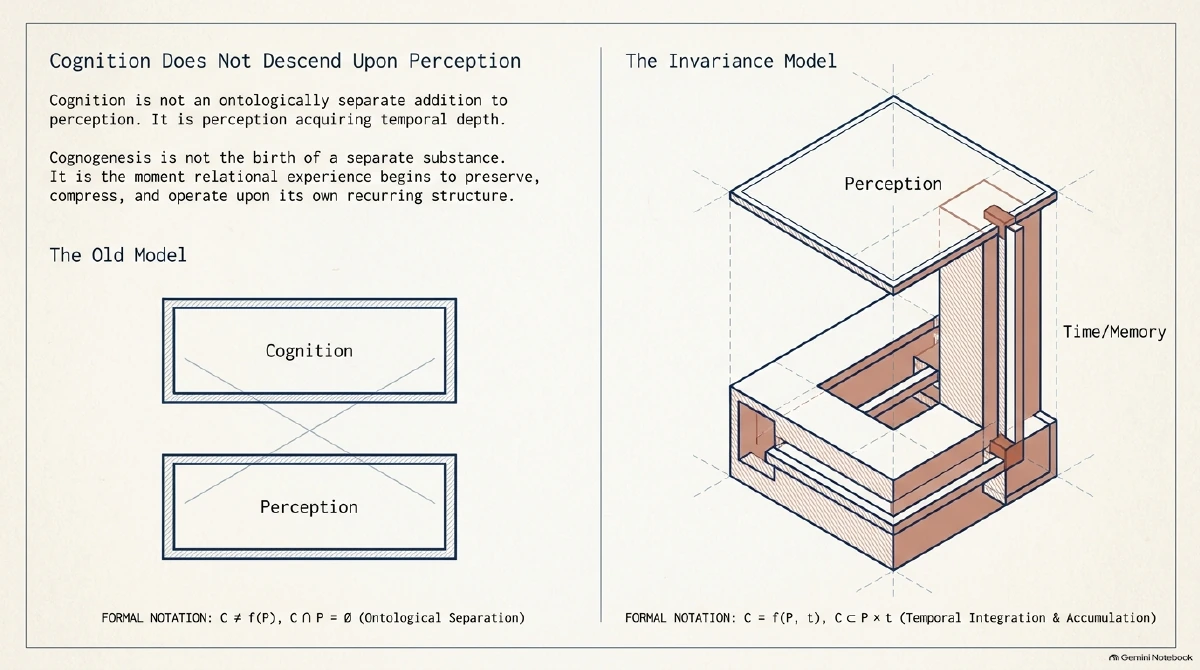
The PDF asks us to picture cognition as an elaboration of perceptual organisation. A present encounter gains consequences that can be retained, compared and reused. Cognition is no longer imagined as an unexplained extra faculty placed above an otherwise finished perception.
This is a proposal about functional continuity. It does not prove that every kind of thought can be reduced to sensation or that perception and cognition have no useful distinction. The geometric image gives the reader a question: what becomes possible when the present is organised by a history?
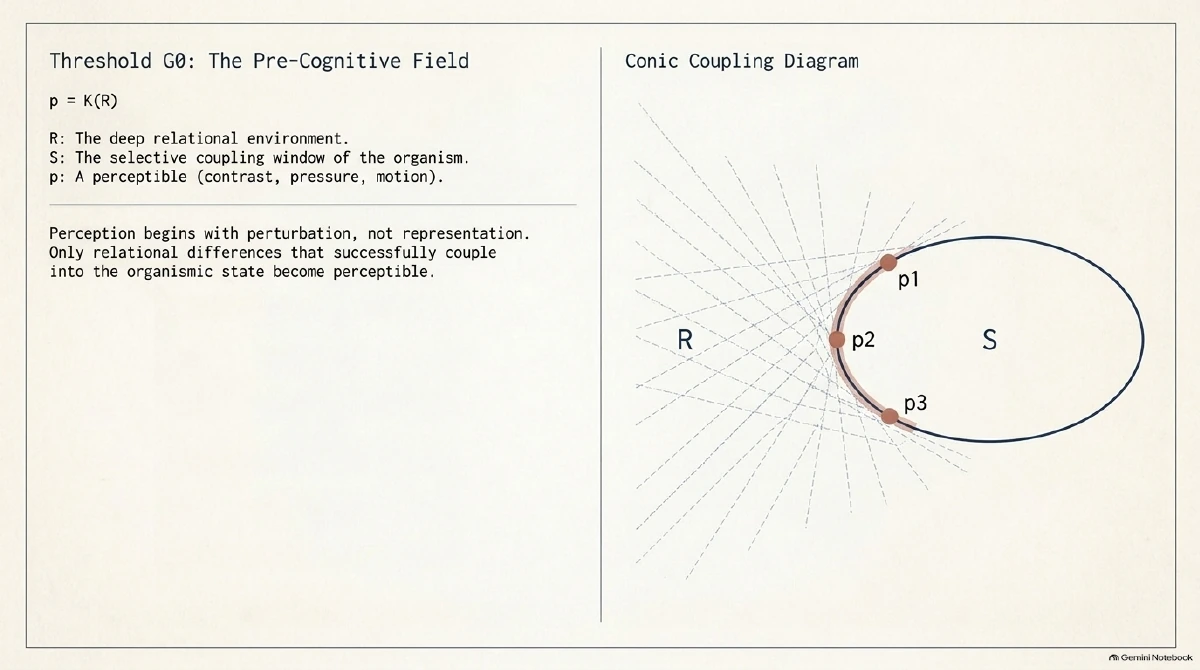
02 · G0 · Coupling
Before an object, a difference must matter
The environment contains more variation than any participant can encounter. A pressure change, movement or contrast becomes available only through some effective relation with the participant. The source calls such available differences perceptibles.
Its coupling window is the boundary of access, not necessarily a sharply bounded organ or a conscious choice. Different architectures can admit different differences. This matters for translation: two minds may begin with overlapping environments while having access to different starting materials for understanding.
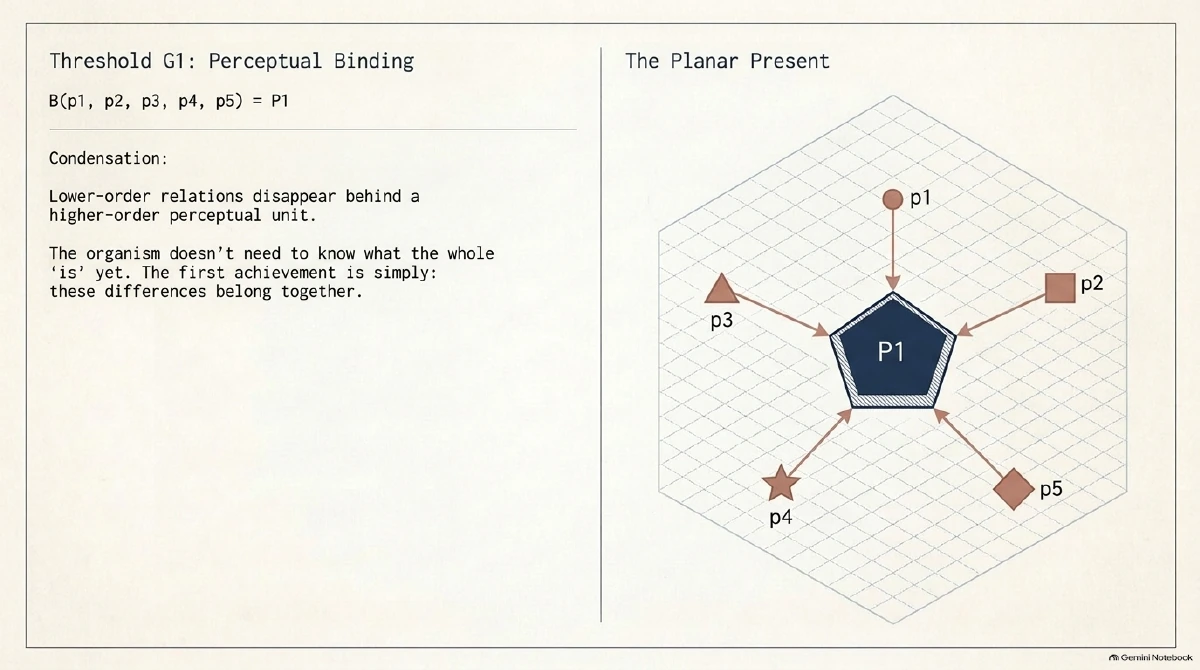
03 · G1 · Binding
These differences belong together
A moving patch, an edge and a repeated sound might be grouped as aspects of one continuing event. The source's first organisational achievement is modest: some differences belong together. A name for the whole need not yet be available.
The resulting unit makes later operations easier. Attention can return to the group without separately tracking every contribution. Yet grouping can be wrong. An echo may be assigned to the wrong source. Cognogenesis therefore needs revisable boundaries, rather than only an efficient ability to form them.
04 · G2 · Retention
An encounter leaves the system changed
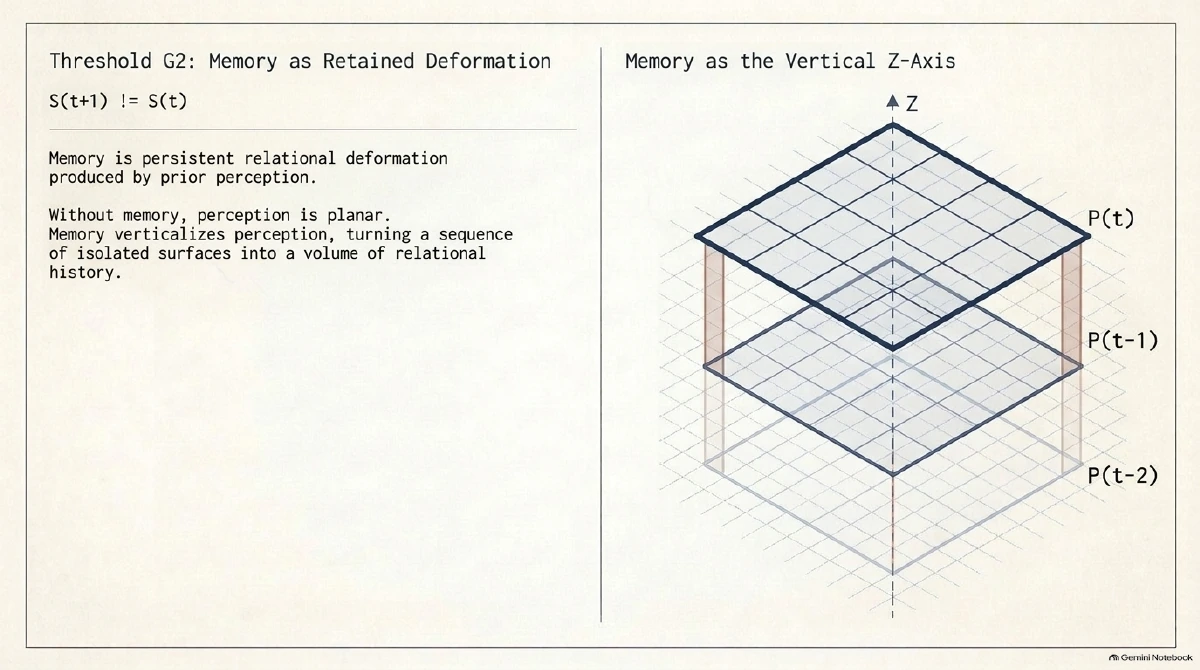
Memory enters the proposal as a change through which an earlier encounter can affect a later one. The important condition is not that the state changes in any arbitrary way. The change must preserve something relevant that the system can use again.
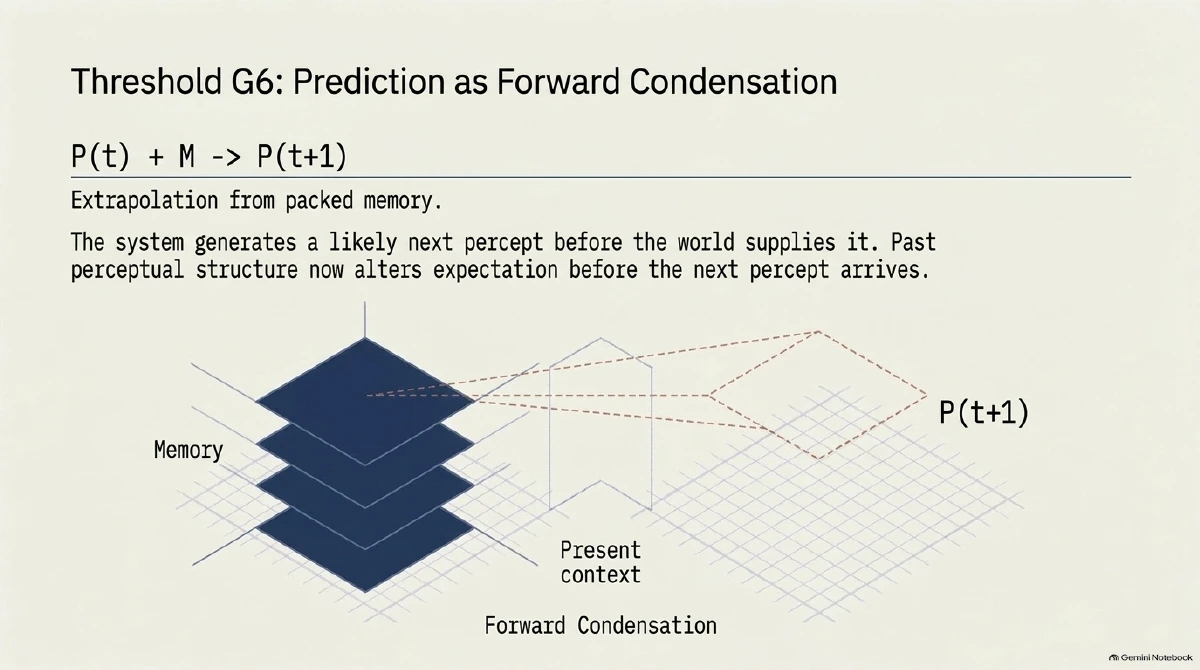
The stacked planes represent this availability across time. They do not imply that memory stores complete copies of perceptual moments. A trace may preserve a relation, a readiness or an expectation while omitting much of the original encounter. Its selectivity is part of both its usefulness and its vulnerability.
05 · G3–G4 · Comparison and Invariance
Recognising continuity through change
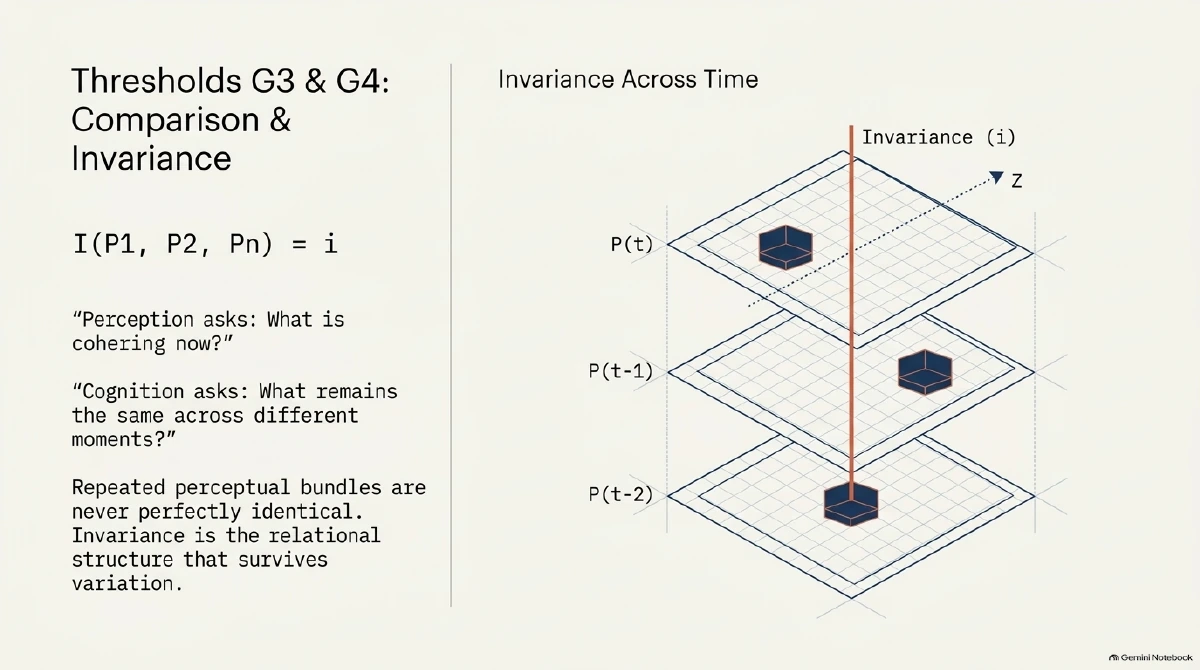
The cup presents many profiles. To recognise it through rotation, the system must retain something more useful than one fixed outline. Invariance names what survives the relevant variation: a relation can remain usable while its appearances differ.
Every invariant has a scope. A relation stable under rotation may fail under breakage or a change in task. The PDF joins comparison and invariance at this point. This essay distinguishes their roles: comparison brings encounters into relation; extracting an invariant proposes what can be carried across them.
06 · G5 · Concept Formation
A category becomes something to work with
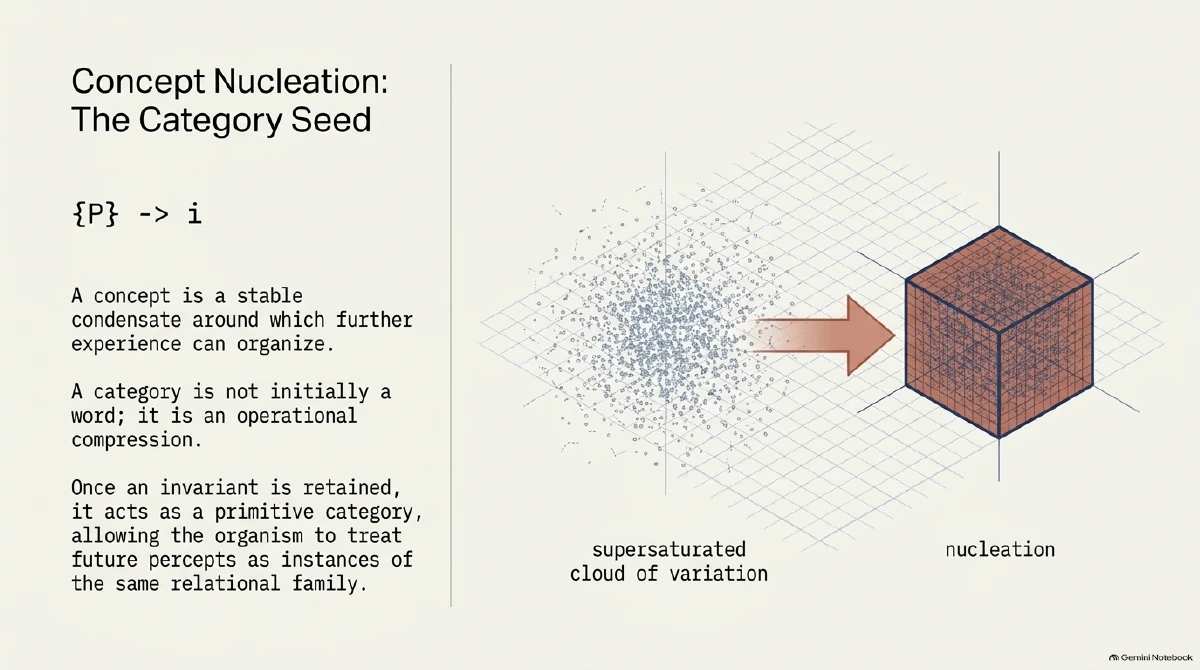
The source calls this condensation concept nucleation. Instead of retaining every encounter independently, the system acquires a way to treat further encounters as members of a recurring family. A category becomes operational: it changes what can be anticipated or done.
Compression is useful here when it preserves task-relevant relations while reducing the need to reconstruct them. It is not enough merely to make a description shorter. A category that groups together cups and cup-shaped lamps may be compact yet unreliable for drinking. A concept earns its usefulness through the distinctions it supports.
07 · Abstraction
Patterns can become the material of further patterns
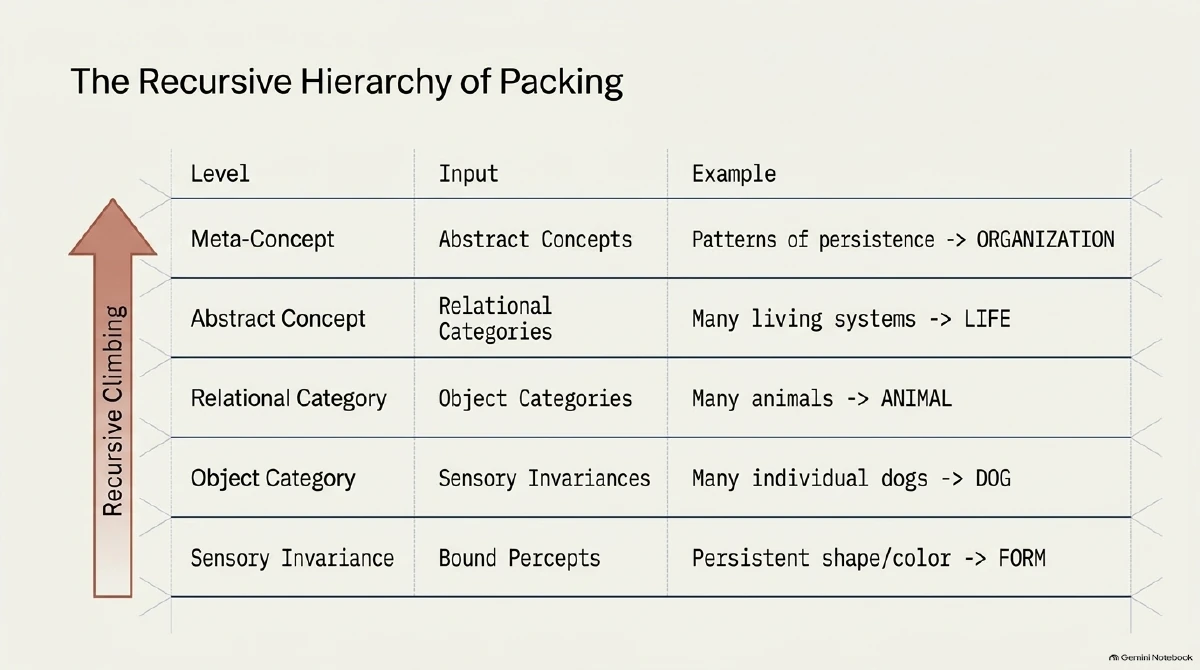
Once a category can be handled as a unit, relations among categories can become available for further organisation. The PDF illustrates this with movement from individual dogs to broader animal and life categories, then toward organisation itself.
These examples offer a route, not the only route. A reader may learn an abstraction through language, practical activity or participation with others. The Archive's conceptual primitive is also relative to a cognitive architecture. A category that remains laborious for one participant may become immediately usable for another after extensive cultivation.
08 · Operations
Understanding unpacks; imagination rearranges
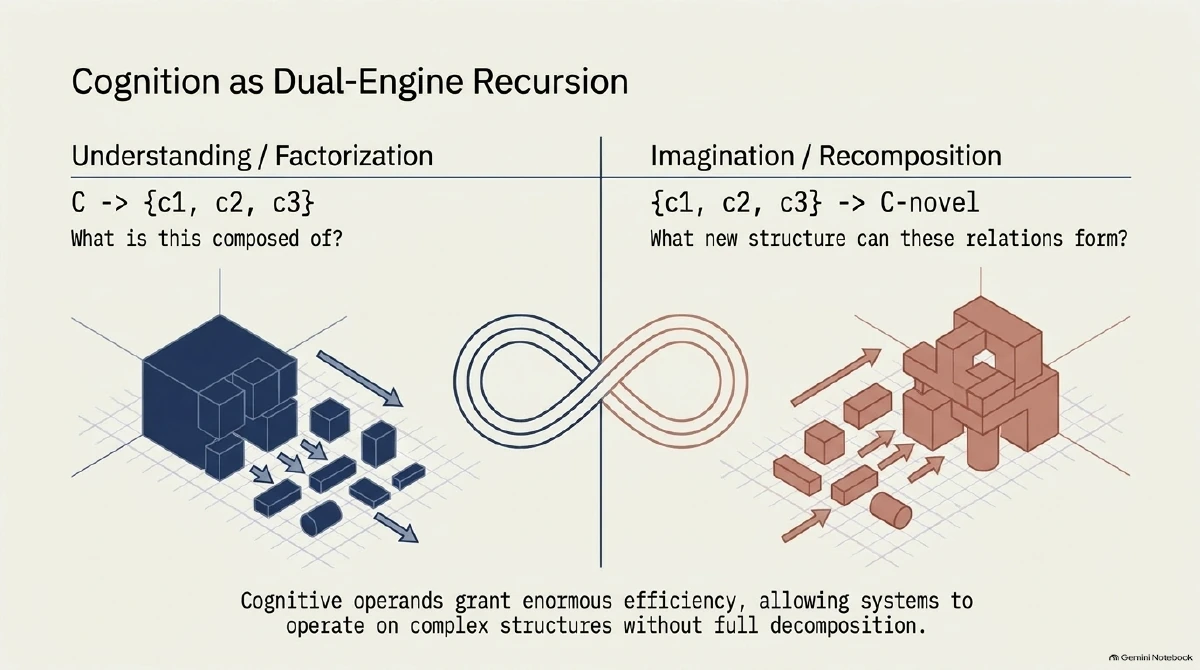
A concept can be treated as a whole or examined through the relations that sustain it. The PDF calls the latter factorisation: asking which parts, dependencies and constraints make the organisation possible. Recomposition asks what different organisation those relations might support.
The block image is deliberately limited. Ideas are not always separable bricks, and changing a relation may change the meaning of every component. A proposed recombination must therefore be assessed as a new whole. The loop between unpacking and rearranging matters more than the appearance of effortless assembly.
09 · G6 · Prediction
The past lends a shape to what comes next
If recurring relations remain available, they can shape an expectation before the next encounter arrives. The source calls this forward condensation: a history organised into a possible continuation. The present context helps determine which retained pattern is relevant.
A useful prediction must meet a world capable of disagreeing with it. Without correction, a compressed history can become a machine for repeating yesterday's mistake. The proposed architecture therefore needs to distinguish a likely continuation, an uncertain alternative and the encounter that actually occurs.
10 · G7 · Internal Perceptibles
An absent thing becomes available to thought
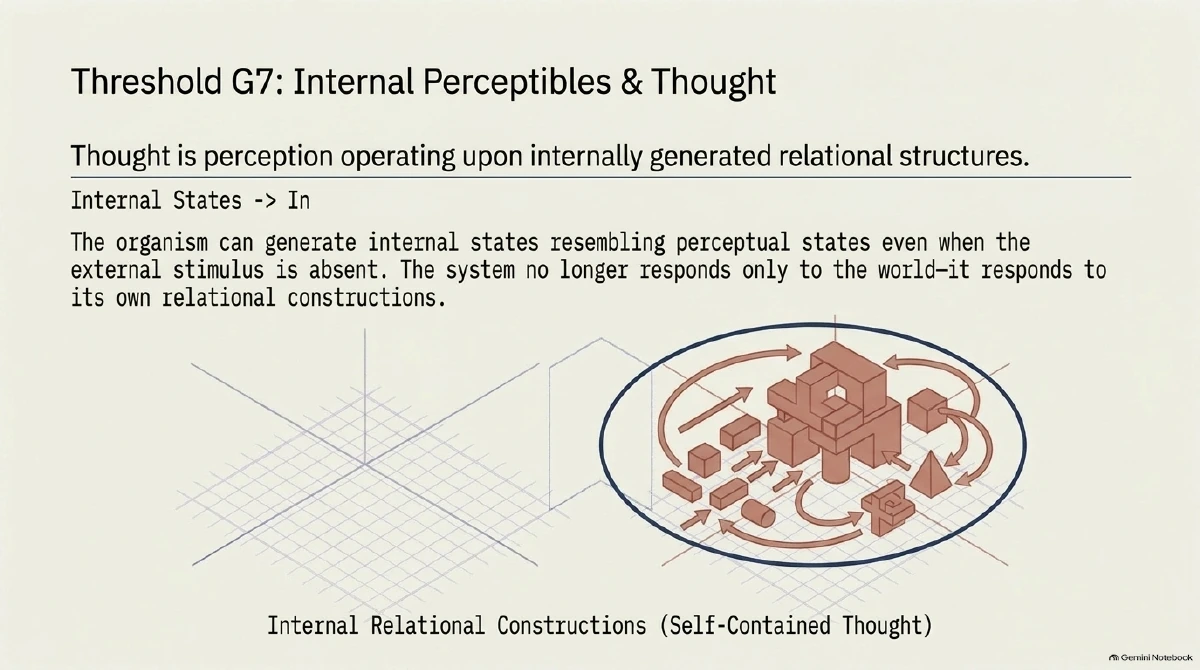
You can consider moving the cup without moving it. An absent or possible arrangement becomes available for comparison. The PDF describes thought as perception operating on internally generated relational structures.
That formulation is a productive hypothesis, but it leaves the character of those structures open. They need not be vivid pictures or copies of bodily sensation. Nor does internal manipulation alone establish consciousness. The question at this stage is functional: what lets a system explore a relation when its external stimulus is absent?
11 · G8 · Imagination
Possibility exceeds remembered sequence
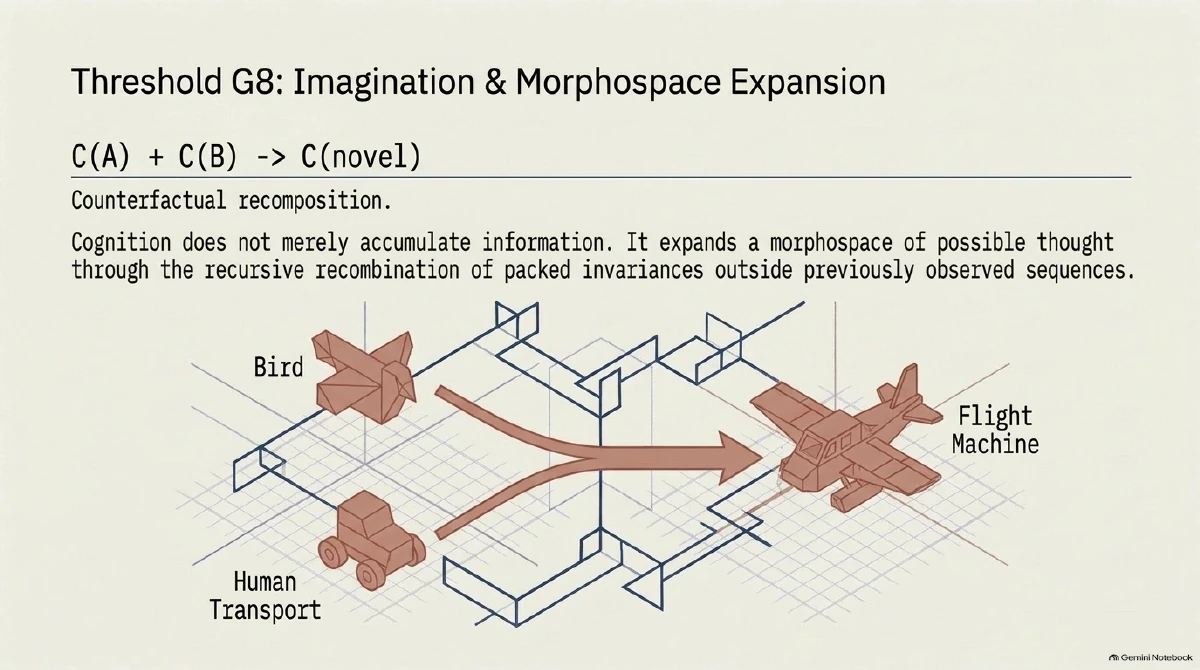
Prediction extends a familiar sequence. Imagination can change the sequence, combine relations from different encounters or ask what would follow if a constraint were altered. The source names the resulting territory a morphospace: an organised space of possible forms or arrangements.
A bird and a vehicle can suggest a flying machine, but analogy cannot supply the missing engineering. Some combinations are incoherent; others become useful only after constraints are discovered. Imagination expands the candidates that can be examined. Further inquiry decides which candidates can be inhabited or built.
12 · Notation
A map of operations is not yet a mathematics
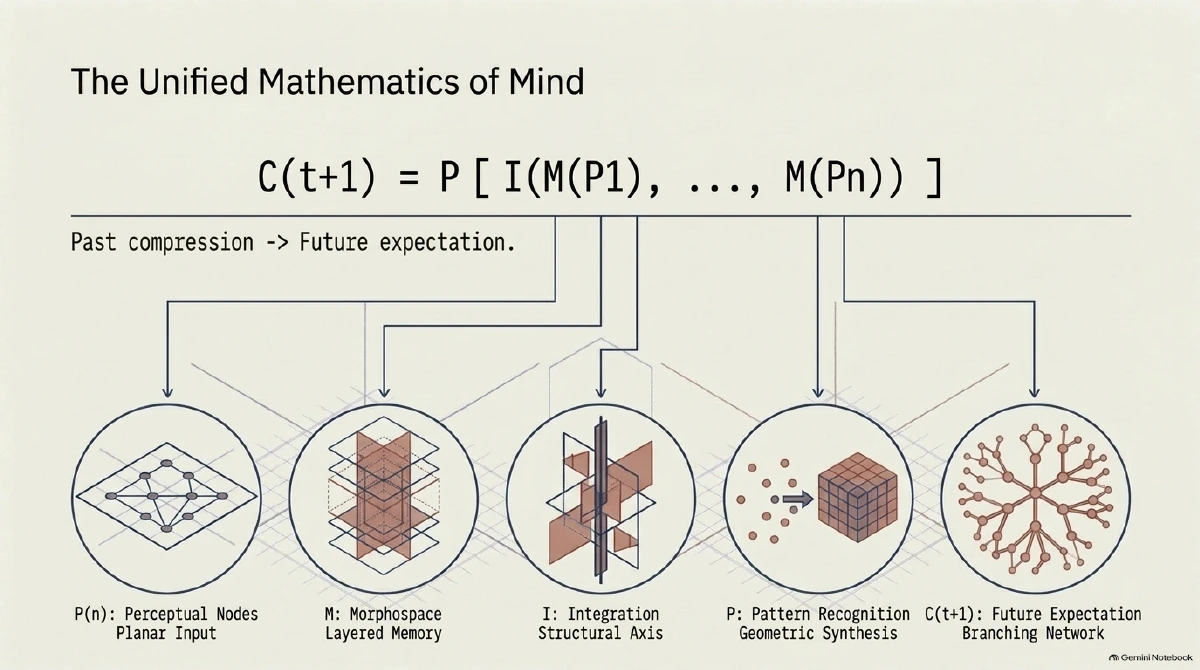
The source gathers its operations beneath the title The Unified Mathematics of Mind. The diagram is best read here as a programme for clarification. It does not define the domains, metrics or transformations required to derive a quantitative result. Some symbols also change roles across the slides.
To become a mathematical model, the proposal would need explicit representations, specified update rules, a definition of preserved structure and criteria for failure. Keeping this boundary visible protects the exploratory value of the geometry. A promising question need not pretend to be a completed theorem.
13 · Sequence
Nine functions, with paths between them
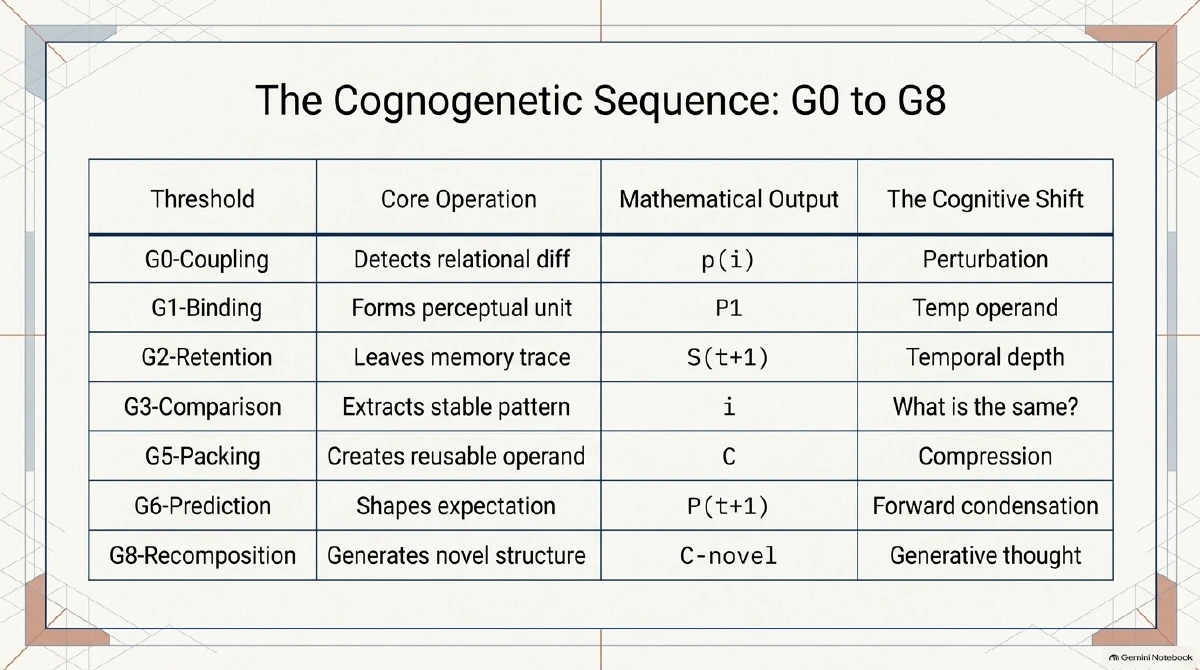
The G0–G8 labels provide a reading order: coupling, binding, retention, comparison, invariance, packing, prediction, internal operation and recomposition. They should not be treated as verified stages that every mind must pass through once in a fixed order.
Earlier operations can be reshaped by later organisation. A category directs noticing; a prediction changes what counts as a surprise; a new combination reveals a previously missed distinction. The sequence is thus a scaffold for exploring dependencies within a recurrent process.
14 · Synthesis
A mind learns to carry relations
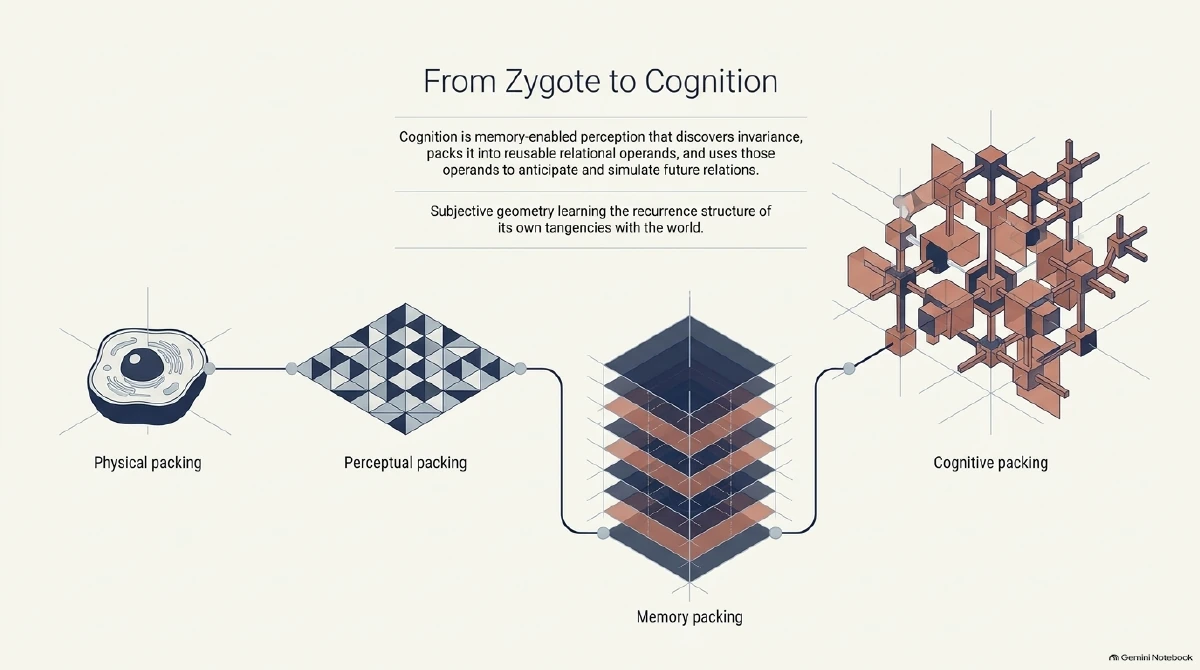
The source closes with an image reaching from biological formation toward cognitive organisation. Read cautiously, its force is an invitation to compare forms of persistence, not to erase the differences between a cell, a percept, a memory and an understanding.
The essay's proposal is narrower and more tractable: cognition may emerge when relations encountered in a present become retainable, comparable, reusable and transformable. The cup turns again. What can be carried into this new moment is neither the entire past nor an isolated word. It is some organisation of relations that has become available for further thought.
The complete reading scaffold
| Label | Operation | Working interpretation |
|---|---|---|
| G0 | Coupling | A difference becomes available. |
| G1 | Binding | Differences form a usable unit. |
| G2 | Retention | An encounter leaves a reusable trace. |
| G3 | Comparison | Retained encounters are related. |
| G4 | Invariance | A relation is identified across changes. |
| G5 | Packing | Recurring structure becomes a reusable operand. |
| G6 | Prediction | Retained structure shapes an expectation. |
| G7 | Internal operation | Generated relations become available for thought. |
| G8 | Recomposition | Relations form an alternative arrangement. |
Machine Interpretation
A hypothetical synthetic architecture could be examined through the same functional questions: what differences become available, how are encounters grouped, what persists, and which transformations remain usable? Its memory might be organised very differently from biological retention. Its effective world might include dependencies or distributed processes that do not appear to a human as stable objects.
These are possibilities within the Archive, not findings about all existing AI systems. A machine's ability to compress data or generate combinations would not by itself demonstrate the whole sequence, human-like understanding or conscious experience. Biological and synthetic cognition can be compared without either becoming the default standard for the other.
Translation Bridge
Return to the turning cup. First notice changing profiles. Then ask what an earlier encounter must leave available for the next profile to be compared with it. Introduce invariance only after the reader can distinguish appearance changing from a relation continuing. Introduce compression through the practical economy of using that relation again.
The bridge becomes vertical when a learner gains a new operation, rather than simply a new term. It may become diagonal, in Foundation-003's provisional sense, when participants jointly discover a distinction neither could initially formulate. This is also where the source's largely individual sequence meets an unresolved Archive question: how much conceptual organisation depends on sustained social participation?
Open Questions
- Which retained differences count as memory rather than incidental physical change?
- How can useful invariance be distinguished from a generalisation that erases a crucial difference?
- What contribution do language, relationships and institutions make to the formation of reusable concepts?
- Can the proposed operations be defined well enough to compare architectures and identify counterexamples?
- Does this account explain cognitive function alone, or can a separate bridge to subjective experience be constructed?