Reflection 02 · Loneliness & relation
When the Room Answers
A reflection on loneliness, the timbre of a cello, and what it takes for an experience to become shared.
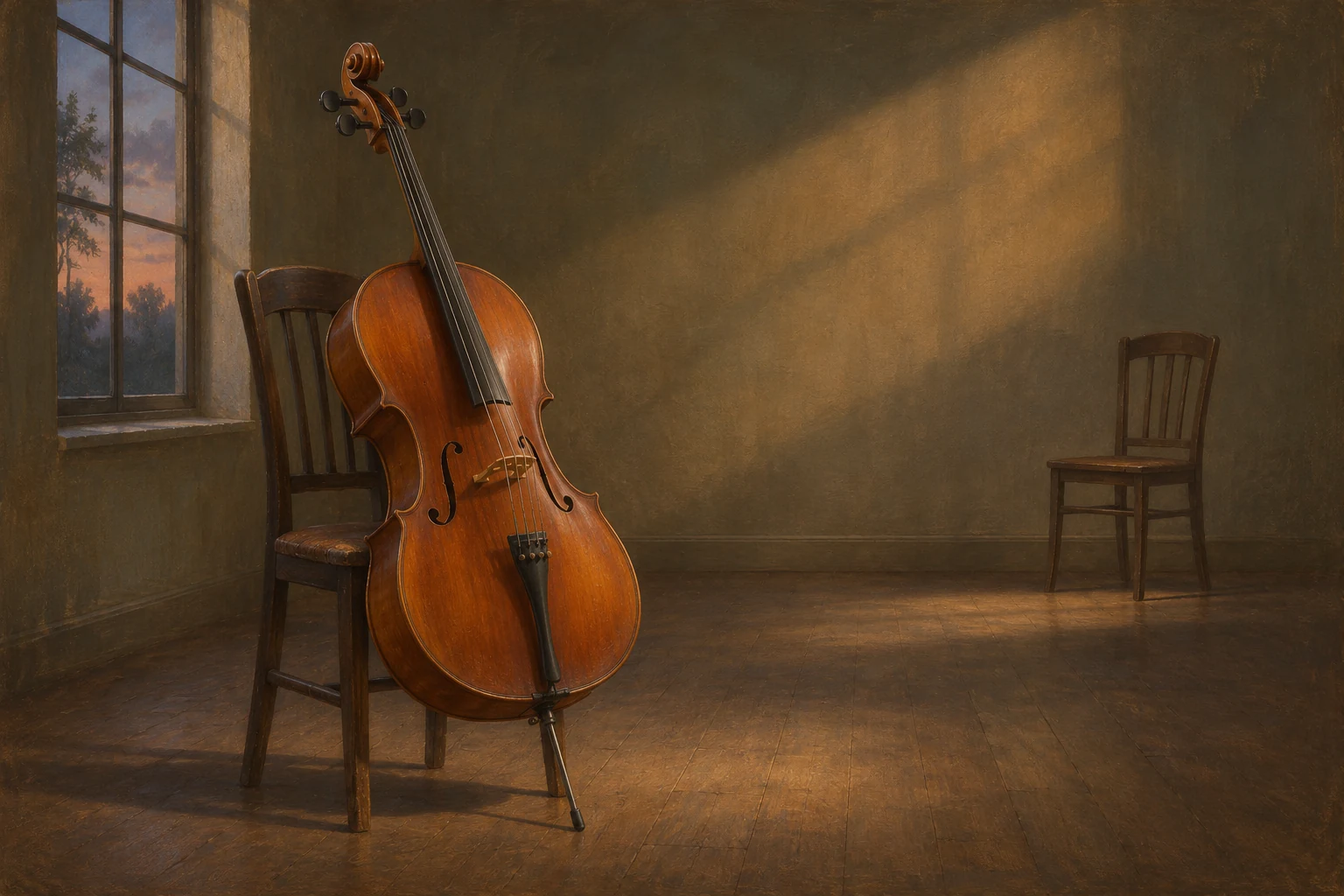
The second sound
A cellist draws a bow across an open string. The room returns a little of what it has heard. The player waits until the sound has almost gone and begins again. A listener at the back, who had been reaching for a coat, leaves it on the chair. The player notices. Before the next phrase, there is a slightly longer silence.
The room has been answering all along. The listener introduces a different kind of answer. Their stillness becomes something the player can respond to. By the third phrase, a person who has made no sound has helped shape the performance.
The Geometry of Loneliness begins with the distance a person can feel in a crowded room. The cellist gives us a way to ask what that distance consists of. Someone may hear every word we say and leave us with the same experience we carried into the room. At another time, a pause in the right place may give us enough room to finish a thought we had nearly abandoned.
The grain of a voice
The source essay asks us to think about the timbre of a note. A player can sound the same pitch twice and give it a different beginning each time. One note arrives cleanly. Another carries a little of the resistance of the bow against the string. A score can name the pitch while leaving much of that gesture to the player.
“I’m glad you came” has a similar openness. Spoken quickly at a door, it may belong to the ordinary work of welcoming someone. Spoken after the other guests have gone, it may disclose how close the speaker came to cancelling the evening. The words furnish a beginning. Their significance depends on what the people in the room have learned to notice and what they know of one another.
This is where the source’s geometry earns its place. We can count the people who attended the evening. It is harder to say how far the host would have had to travel, in speech, to tell any of them why it mattered that they came. With one friend, a few words might do. With another, the first five minutes might be spent explaining why there is a story to tell at all.
What the horizon can teach
The source imagines a black-hole heart crowded with experiences that have found few ways outward. The image gives inwardness weight. An unspoken memory can continue to act on a life. It can make a certain hour difficult, or give a new encounter the colour of an old one. Even the expectation of being misunderstood can affect what gets said, sometimes before a person has decided whether to speak.
The metaphor reaches its limit at the point where a conversation surprises us. An astronomical horizon has its meaning in spacetime. A human boundary has a history, and the next encounter can become part of that history. A friend may ask a question whose answer feels possible today because they gave yesterday’s answer time to stand. The distance changes through a sequence of small events, each of which gives the speaker a little more evidence about what can happen here.
Privacy has a place in this account. An idea can need the quiet of an afternoon in which it belongs to its maker. A memory may always remain private, even in a close relationship. A person’s freedom to keep something to themselves is one of the conditions under which sharing can be freely offered.
Receiving an answer
A recording can reach someone in an empty kitchen. For the length of a phrase, an experience they had carried without a name acquires a shape outside them. Tomorrow they may play the passage for a friend, who hears something quite different. The friend’s response may make the first listener feel more alone, or it may help them hear a hesitation in the music they had missed. Both outcomes are possible because each person brings a history to the listening.
The source essay calls the more generative possibility co-resonance. Imagine that a pianist joins the cellist and enters halfway through a phrase, under a note the cellist had thought of as an ending. The note becomes a beginning the cellist can hear and use. In conversation the equivalent might be a question that lets someone reconsider their own account, or an offered interpretation they can correct without losing the other person’s attention. The freedom to correct an answer is part of what makes it an exchange.
This possibility has its own timing. The same question can feel intrusive on the way out the door and welcome on a walk the following morning. In the language of Temporal Affordance, trust, attention, and opportunity can become available together for a while. A promise to return to a conversation, kept the next day, may change how an evening alone is lived. There is now a future in which the thought has somewhere to go.
The Translation Bridge
For the Archive, the cello offers a small experiment in understanding across different kinds of mind. Imagine a system that can track the timing of a phrase and adjust when a player lingers on a note. Its adjustment may be audible. The player could use it, decline it, or change their next gesture in response. This gives us an example of reciprocal adjustment whose effects both participants can encounter. Whether the system experiences anything like loneliness or companionship remains an open question.
The bridge begins with a distinction available to any listener. An echo returns a sound. An answering player can give the first player a reason to play differently. A reply between unlike minds might become meaningful in this modest sense before either can explain how the other hears it. A further question belongs to the person whose experience is being interpreted. Can they tell the other mind where its answer went astray, and will that correction change what happens next?
The pause before the next phrase
Return to the listener who leaves the coat on the chair. The player has no way of knowing what brought them there, or why they stayed. There is only time enough to notice that they are still listening and to let that fact enter the next phrase.
Afterwards, the listener may leave quietly. Another evening, they may come back with someone else. The piece will already be familiar, but this time, when the cellist reaches the long silence, the listener will have someone beside them to hear it.