The Art of Being Broccoli
A Sprout, a Universe, and the Misunderstanding of More
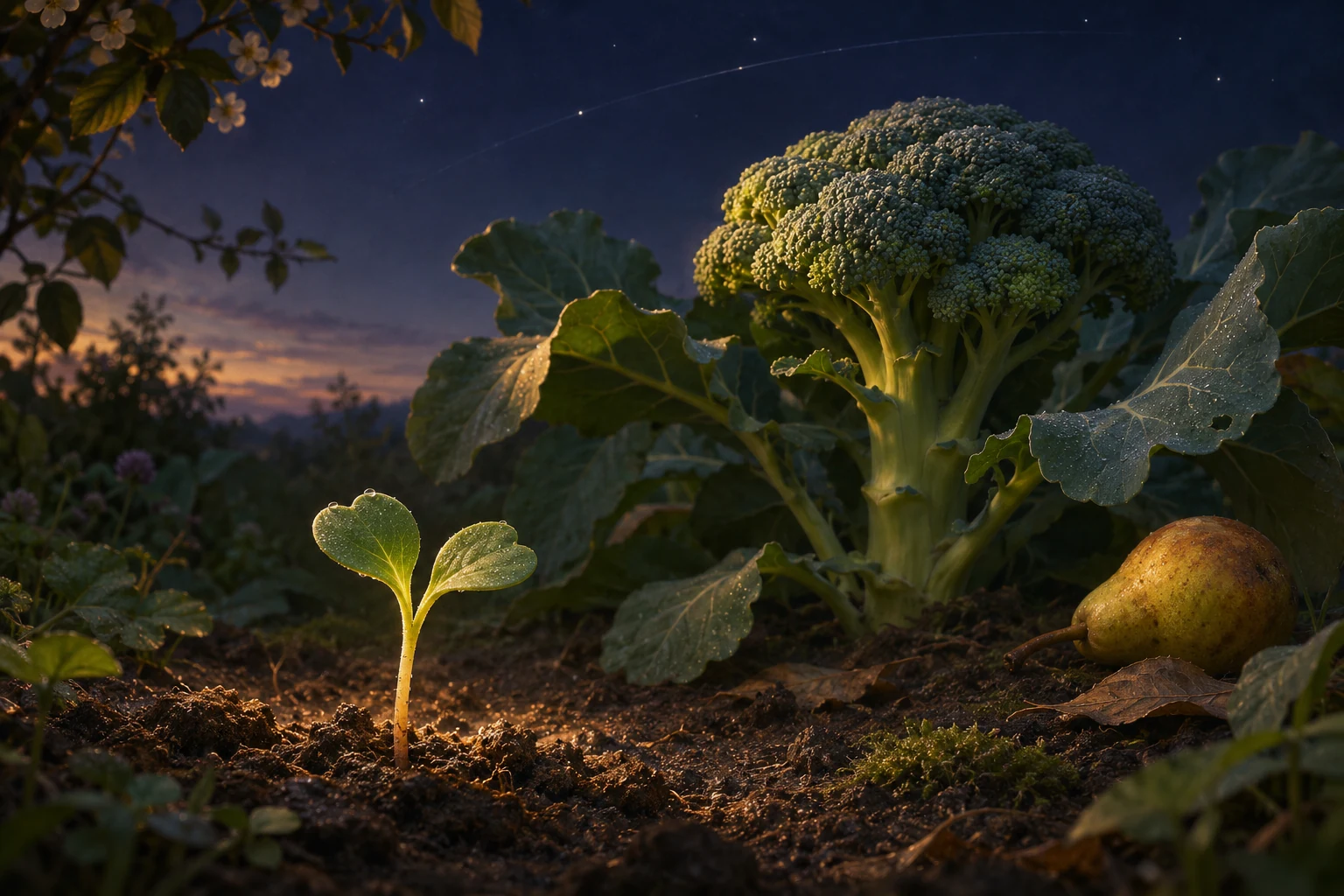
The Continuum Archive | Reflections on the Art of Being
Themes: Becoming · Biological Possibility · Relational Existence · Temporality · Conditional Value · Morphogenesis · Environmental Affordance
I. The Smallest Broccoli in the Universe
Once upon an ordinary scientific afternoon, someone discovered that a tiny broccoli sprout contained considerably more of a particular chemical compound than its mature counterpart.
This was exciting.
The sprout was suddenly celebrated. It had apparently beaten its elders in an invisible chemical competition. Three days old, hardly a respectable age for a vegetable, and already the champion of glucoraphanin.
The adult broccoli stood silently in the garden.
Nobody asked whether it had entered the competition.
Nobody asked whether it wished to be judged by the chemical inventory of its childhood.
And nobody asked the sprout whether its abundance was a triumph, a necessity, or merely a temporary arrangement demanded by the circumstances of being small.
Perhaps our first mistake was assuming that the two plants were competing at all.
We measured the chemical quantity correctly, perhaps, but understood the comparison incorrectly.
For what does it mean to say that a sprout possesses more of something?
More relative to what?
More necessary for which situation?
More beneficial to which organism?
More useful at which moment in the unfolding history of life?
These questions do not diminish the scientific observation.
They reveal the immense metaphysical territory hidden beneath it.
The laboratory measured a concentration.
We nearly mistook it for a verdict on existence.
II. The Arrogance of the Measuring Spoon
Human beings possess an extraordinary affection for quantities.
We count, compare, rank, optimize and arrange the world into ascending and descending hierarchies.
An apple contains this much sugar. A pear contains that much water. A broccoli sprout contains ten times, twenty times, perhaps a hundred times more of a particular compound than a mature vegetable under particular experimental conditions.
The greater number appears to smile triumphantly.
But nature does not necessarily organize its existence around our rankings.
A newborn human possesses different physiological proportions from an adult. A caterpillar is chemically unlike a butterfly. An autumn leaf is not a failed spring leaf because its chlorophyll has diminished.
Nor is an elderly tree necessarily inferior to its seedling because its resources have been redistributed among roots, branches, bark, leaves, flowers and an enormous living architecture.
Quantity is a coordinate of a condition.
It is not the condition itself.
A seed might possess a concentration of defensive compounds because its early circumstances demand a particular organization of chemical resources.
An adult plant might require less of that compound in a given tissue because its biological responsibilities have changed.
It has acquired structures, relationships, distributions and capacities unavailable to the seed.
What appears to be chemical loss may sometimes be functional reorganization.
What appears to be abundance may be temporary necessity.
The seed is not richer because the adult is poorer.
They inhabit different questions.
And perhaps biology, when viewed too exclusively through numerical comparison, risks answering a question that existence never asked.
III. A Seed Is Not an Unfinished Adult
Consider a seed.
It is small, silent and apparently inactive.
We might imagine it as an incomplete plant, a preparatory object whose importance consists in eventually becoming something larger.
But this interpretation secretly places the adult plant at the center of existence.
The seed becomes meaningful only through its destination.
What an injustice to the seed!
A seed is already a complete organization of its present possibilities.
It has a coat, an embryo, stored resources, protective chemistry and an extraordinary dependence upon conditions that have not yet arrived.
It waits, although waiting should not be mistaken for conscious expectation.
It responds, although response does not require intention.
It remains viable, sometimes for remarkably long periods, while the surrounding world changes.
Water arrives.
Temperature permits.
Oxygen becomes available.
Metabolism awakens.
The seed begins to germinate.
But why should we describe this event simply as the seed becoming a plant?
It was already a plant in one of the forms that plant existence can take.
Germination is not an escape from incompleteness.
It is a transition from one organization of possibilities into another.
And perhaps the philosophical error lies in treating development as a staircase toward superiority rather than a succession of conditional forms.
The seed is accomplished in seedhood.
The sprout is accomplished in sprouthood.
The adult is accomplished in adulthood.
Their achievements cannot be reduced to how closely they resemble one another.
IV. The Day the Broccoli Escaped the Calendar
Suppose we take four genetically identical broccoli seeds.
We give them the same chronological beginning.
One grows under gentle Mediterranean sunlight.
Another experiences cool mountain nights.
A third encounters drought.
The fourth travels into an orbital laboratory, where the familiar gravitational world has been transformed.
After five days, we gather our specimens.
They are all five days old.
But are they the same age in the deeper sense of having undergone equivalent biological histories?
Their clocks may agree.
Their chemistry may not.
Light, gravity, temperature, water availability, mineral resources and previous stresses influence how plants develop and regulate their metabolism.
Even among plants sharing the same chronological age, the composition of biological circumstances may be profoundly different.
And here our little broccoli accomplishes a magnificent philosophical rebellion.
It escapes the calendar.
Not because time has ceased to exist, but because chronological duration alone is insufficient to describe the history through which a living form has become what it is.
Five days in one environment are not biologically identical to five days in another.
The clock measures duration.
The organism embodies a history of interactions.
We might therefore imagine that the biological present is not merely a point on a timeline.
It is the temporary composition of everything that has occurred, everything currently interacts, and everything the organism remains capable of doing.
A sprout is not simply three days old.
It is three days of becoming under particular conditions.
And perhaps that distinction is immense.
V. The XYZT Garden
Imagine an extraordinary garden.
Not a garden arranged according to familiar botanical categories, but one in which every plant occupies a unique position in a vast landscape of conditions.
There are coordinates of location and time.
There are gradients of illumination, moisture, temperature, pressure, nutrition and microbial companionship.
There are histories of drought, abundance, disturbance, recovery and adaptation.
Each plant exists within this intersecting complexity.
We might write, playfully:
Where environment, history and relationships accompany space and time.
This is not a scientific formula claiming to calculate the entirety of plant existence.
It is a philosophical map.
Its purpose is to remind us that an organism cannot be adequately understood as a list of quantities detached from the conditions in which those quantities matter.
In one region of the garden, a particular chemical allocation may offer an advantage.
Elsewhere, another allocation may be more useful.
Under one condition, a defensive compound may be important.
Under another, resources devoted to growth, structural strength or reproductive development may be more consequential.
There is no reason to assume that the greatest concentration of a single compound represents the greatest biological accomplishment.
The geometry of usefulness changes with the world.
And suddenly our garden is no longer an exhibition of plants possessing properties.
It becomes a field of relationships in which properties acquire significance.
VI. The Broccoli Meets an Insect
Now let us invite another organism into the garden.
An insect arrives.
To the broccoli plant, certain chemical compounds participate in defense against herbivores.
To one insect, those compounds may be deterrents.
To another, adapted insect, they may provide information about where a suitable host plant can be found.
The chemical has not changed merely because the visitor has changed.
Yet the relationship has.
A molecule that participates in protection for one organism becomes a navigational clue for another.
Now a human arrives and eats the broccoli.
Some of the same plant compounds enter an entirely different biological architecture.
The human digestive system, enzymes and gut microorganisms influence how they are transformed.
Among the resulting compounds, sulforaphane can interact with cellular pathways involved in responses to stress.
Not every interaction is beneficial.
Not every quantity produces the same effect.
Not every person responds identically.
But the philosophical significance is irresistible.
The chemical does not possess one universal meaning.
Its biological consequences emerge through encounters.
To the plant, it participates in one system of functions.
To the insect, another.
To the human, another still.
The same molecular visitor enters different worlds of significance.
Perhaps usefulness does not reside entirely in the object.
Perhaps usefulness is an event occurring between an object's capabilities and another system's conditions.
A broccoli sprout contains chemistry.
But it does not contain every consequence that chemistry may eventually produce.
Those consequences require a world.
VII. The Art of Having Enough
We often imagine abundance as the desirable condition.
More resources.
More defenses.
More nutrients.
More possibilities.
Yet life must distribute limited resources among competing functions.
An organism cannot allocate everything toward every possible future simultaneously.
The seed faces one constellation of challenges.
The sprout faces another.
The mature plant faces still another.
The proper question may not be how much a living system possesses, but whether its organization is sufficiently responsive to the conditions it encounters.
Enough is a relational concept.
There is no universal quantity called enough floating independently through the universe.
Enough water for a cactus is not enough water for a rice plant.
Enough light for one species may overwhelm another.
A concentration of one defensive compound may be advantageous in a particular ecological situation yet unnecessary or costly in another.
The art of being alive is therefore not simply the accumulation of beneficial quantities.
It includes the continual allocation and transformation of resources under constraints.
Life is not an infinite warehouse.
It is an ongoing composition.
And perhaps its elegance lies not in possessing everything, but in continually negotiating what can be maintained, transformed, abandoned or newly formed.
The mature broccoli has not necessarily forgotten the chemical abundance of its youth.
It may simply have moved on to different problems.
VIII. The Pear Enters the Garden
At this point, a pear falls from a neighboring tree.
It has been watching the broccoli with considerable amusement.
The pear has its own difficulties with time.
While firm and apparently beautiful, it may offer little sweetness or softness. Then its ripening accelerates. Aromas appear, flesh softens, and an exquisite edible interval opens.
But the interval is precarious.
A little too early, and the pear seems unfinished to our palate.
A little too late, and microbial decomposition begins taking the fruit in another direction.
The pear knows something the broccoli is only beginning to explain.
Being desirable is not the same thing as being maximally developed.
The pear's finest moment for eating exists within a convergence of chemical transformation, sensory preference, storage conditions and human timing.
But even when it becomes unsuitable for eating fresh, the story does not necessarily end.
The fruit might become part of fermentation, compost or another ecological process.
Its usefulness has changed because the relationships available to it have changed.
The broccoli nods.
The pear replies:
"Perhaps the problem is that humans keep asking which moment of our existence is best, without telling us what they intend to do with us."
The broccoli considers this.
"Indeed. Apparently, I was more chemically impressive when I was three days old."
"And I," says the pear, "am admired most enthusiastically during the brief interval before I begin collapsing."
Both contemplate humanity's unusual devotion to perfectly timed consumption.
Then the pear asks:
"Have they ever considered that we are not living primarily for their nutritional rankings?"
The broccoli, being a philosophical vegetable, offers no immediate objection.
IX. The Orbiting Sprout and the Problem of Everywhere
Now we return to our most adventurous broccoli.
A seed travels into orbit.
Its environment changes.
The familiar downward direction is no longer available in the same way.
Fluid behavior, gas exchange and growth orientation may differ.
Light must be supplied through an engineered system.
Water behaves differently.
The plant encounters conditions unlike those under which generations of its ancestors evolved.
What should it do?
It cannot consult a universal instruction declaring that on day three it must contain precisely a predetermined amount of glucoraphanin.
Its developmental regulation operates through interacting molecular systems influenced by conditions.
Experiments investigating plants under altered gravity have shown that environmental change can influence growth and metabolism. Yet the full consequences for broccoli chemistry in genuine orbital cultivation remain incompletely characterized.
This uncertainty is not an inconvenience to the philosophical inquiry.
It is the doorway.
Because if we define broccoli only by what terrestrial broccoli normally does, then the orbital broccoli appears abnormal.
But perhaps the concept of normality itself depends upon an assumed environment.
On Earth, gravity has been a persistent condition of plant evolution.
In orbit, the conditions differ.
Which broccoli is the proper broccoli?
The one growing under familiar constraints?
Or the one expressing its available biological responses under unfamiliar constraints?
Neither question can be settled by declaring one chemical concentration superior.
The organism must be understood in relation to the world it actually inhabits.
And what a peculiar thought:
A broccoli sprout in orbit might teach us not only about plants in space, but about the assumptions hidden in our earthly definitions of plant development.
X. History Lives in the Present
Suppose two plants possess identical measured concentrations of glucoraphanin today.
One has grown under stable, favorable conditions.
The other has experienced drought, recovered and encountered new conditions.
Are they biologically identical?
We cannot assume so.
The measured compound is only one component of a much larger biological state.
Differences may remain in gene expression, metabolism, developmental organization or the capacity to respond to subsequent stress.
Plants can exhibit various forms of physiological stress memory and priming, although these processes differ by species, stimulus and timescale.
This suggests something profound.
The present is not merely what currently exists.
It is also what previous conditions have made possible or constrained.
A plant's history can influence how it responds to what comes next.
There is an echo here of memory, though not necessarily memory in the conscious human sense.
A changed response can persist even without recollection.
Perhaps the biological present is a kind of compressed history.
Not a history written in sentences, but one expressed in molecular arrangements, regulatory states and developmental structures.
The organism carries aspects of its past into its future possibilities.
And so our broccoli becomes a tiny philosopher of time.
It does not need to know yesterday to be influenced by yesterday.
It does not need to imagine tomorrow for its current organization to affect tomorrow's outcomes.
Its life exists at the intersection of inherited structure, present conditions and possible futures.
XI. The Difference Between Having and Being Able
Here, perhaps, we arrive at the deepest question.
What distinguishes having a substance from being able to do something?
A seed has stored resources.
But possessing resources is not identical to possessing an unlimited capacity to use them.
A plant may contain compounds whose physiological functions depend on enzymes, cellular locations, developmental signals and environmental conditions.
A human may consume those compounds without absorbing or transforming them in exactly the same way as another human.
What matters is not only chemical possession.
It is the organization of interactions through which substances acquire consequences.
There is a difference between inventory and capacity.
Between quantity and affordance.
Between what is present and what becomes possible through its presence.
A violin possesses strings.
A cello possesses strings.
But counting their strings will not explain the entirety of the music each instrument can produce.
The music requires structure, tension, material, resonance, movement and interaction.
Likewise, the chemistry of a plant cannot be understood entirely through a numerical inventory.
Its biological significance depends upon organization, transformation and relation.
The sprout is not merely a container full of glucoraphanin.
It is a living system in which glucoraphanin occupies a particular role among countless interacting processes.
And when consumed, some of its molecular components enter another system of possibilities.
The molecule remains a molecule.
Its role changes.
Perhaps this is one of nature's recurring artistic gestures:
The same material participates in many different forms of becoming.
XII. No Universal Champion of Existence
We can now return to our original competition.
The tiny sprout stands beside the adult broccoli.
The scientist holds a notebook.
The chemical measurements remain valid.
One sample contains more of a particular substance than another.
Nothing in our reflections requires denying that fact.
But the notebook cannot tell us, from this measurement alone, which stage of broccoli is universally better.
Better for seed survival?
Better for growth under drought?
Better for resistance to a particular insect?
Better for a particular person's nutritional needs?
Better for sulforaphane bioavailability?
Better for a pleasant dinner?
Better for an orbital cultivation experiment?
Each question may require a different measurement and a different answer.
And in some cases, we do not yet possess sufficient evidence to answer at all.
This is not the defeat of measurement.
It is its liberation from an impossible responsibility.
A number should not be asked to carry the entire metaphysical burden of value.
It can tell us what was measured.
It cannot, without further context, tell us what ought to matter.
There may be no single champion of broccoli existence.
There may instead be many forms of conditional adequacy, flourishing, adaptation, vulnerability and usefulness.
Even these terms must be handled carefully, because nature contains failures, harmful interactions and irreversible losses as well as successful adaptations.
Not every possible condition is favorable.
Not every response is advantageous.
But no organism can be understood fully by removing the circumstances within which its responses become meaningful.
XIII. The Art of Being
What, then, is the art of being broccoli?
Perhaps it is not to maximize glucoraphanin.
Nor to remain forever young.
Nor to reach adulthood as quickly as possible.
Nor to preserve the chemistry of the seed inside the body of the mature plant.
Perhaps the art lies in the continuous organization of living processes as conditions change.
A seed is not merely waiting to become important.
A sprout is not merely a more nutritious version of an adult.
An adult is not merely a depleted sprout.
Each developmental form participates in a different arrangement of constraints and possibilities.
And none can be understood without the world that surrounds it.
The pear contributes its lesson of ripening.
The broccoli contributes its lesson of chemical transformation.
Together, they suggest that the value of a living form cannot always be separated from its temporal and relational circumstances.
There is no need to declare every stage equally beneficial for every purpose.
Indeed, the evidence often says otherwise.
But there is reason to abandon the assumption that one isolated property establishes a universal hierarchy of being.
Existence is not a competition between successive versions of the same organism.
It is a history of changing forms, each interacting with conditions that may permit, restrict or redirect what comes next.
And perhaps the most beautiful thing about our little broccoli is that it never needed to know any of this.
It simply germinated.
Its cells divided.
Its chemistry changed.
Its roots explored.
Its leaves unfolded.
Somewhere, a scientist counted molecules.
Somewhere else, a pear ripened too quickly.
And in an imagined orbital garden, a broccoli sprout encountered a world in which even the familiar direction of down had become uncertain.
Still, the sprout continued its biological negotiations.
Not toward a universally perfect broccoli.
Not toward the greatest possible quantity of one chemical.
But through the immediate and changing conditions of being.
And so, after all our measurements, equations, comparisons and metaphysical adventures, we return to a modest little seed.
Within it, no fully predetermined catalogue of every future circumstance.
No conscious map of every possible environment.
No promise of success.
Only an inherited organization capable, under suitable conditions, of entering into a remarkable sequence of transformations.
Perhaps that is enough for the beginning of a philosophy.
To be is not merely to possess properties. It is also to participate in conditions through which properties acquire consequences.
The sprout has not defeated the adult.
The adult has not superseded the seed.
And the pear, for once, has managed to remain ripe throughout the entire discussion.
A small miracle of philosophical timing.
Epilogue: A Conversation in the Continuum Garden
The Pear: "When am I best?"
The Broccoli: "For whom?"
The Pear: "When am I ready?"
The Broccoli: "For what?"
The Pear: "When have I become everything I was meant to be?"
The Broccoli: "Under which conditions?"
The pear considers the questions.
Then, with considerable dignity, it falls into the grass.
The broccoli remains standing.
Neither has won.
The garden continues.
Continuum Archive
Reflection Collection: The Art of Being
Companion reflection: The Pear, Ripeness, and the Temporal Affordance of Being
Keywords: broccoli, broccoli sprouts, glucoraphanin, sulforaphane, plant development, conditional existence, biological affordance, temporality, morphogenesis, environmental history, relational value, philosophy of biology, plant stress memory, orbital agriculture, art of being
Authorial note: This reflection draws inspiration from research on broccoli glucosinolates, plant developmental biology, environmental responses and sulforaphane. Its metaphysical interpretations, dialogues and conceptual equations are philosophical explorations, not established scientific theories. The references to broccoli in orbit distinguish documented space experiments from hypothetical developmental comparisons.
Archive reading notes
Purpose
To ask what a valid chemical comparison can tell us about a living form at a particular stage of development.
Core Idea
A measured property describes one aspect of a living system. Its consequences depend on how the system is organized, what has happened to it, and what it encounters.
Human Interpretation
The pear makes the question practical. The same fruit can be too soft for eating fresh and ready to contribute to fermentation. Each use brings its own conditions and timing.
Machine Interpretation
A hypothetical synthetic system could record a concentration alongside the tissue sampled, its developmental stage, and the conditions under which it grew. Estimating what the compound makes possible would require evidence about the proposed encounter, such as the insect species and its response.
Translation Bridge
Start by asking what “more” measures. Then ask “enough for what?” and “available to whom?” The shift from quantity to consequence gives us a way to compare encounters across organisms with different capacities.
Open Questions
Which traces of an organism’s history matter for its next encounter? How much of that history can we infer from a measurement taken today?
Related Concepts
Temporal Affordance follows the pear’s ripeness into a wider inquiry about how conditions open and close possibilities.